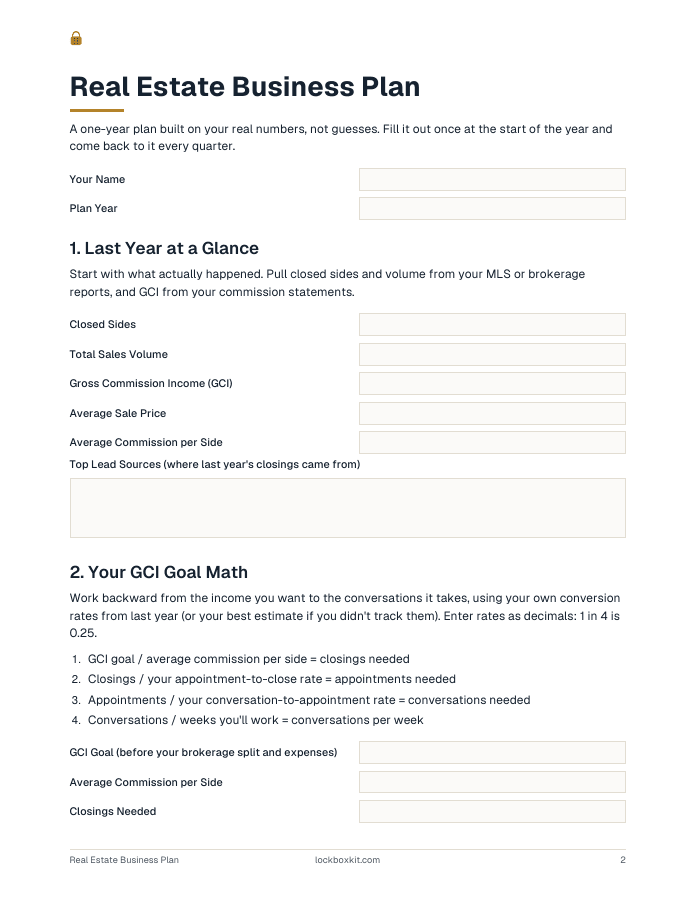
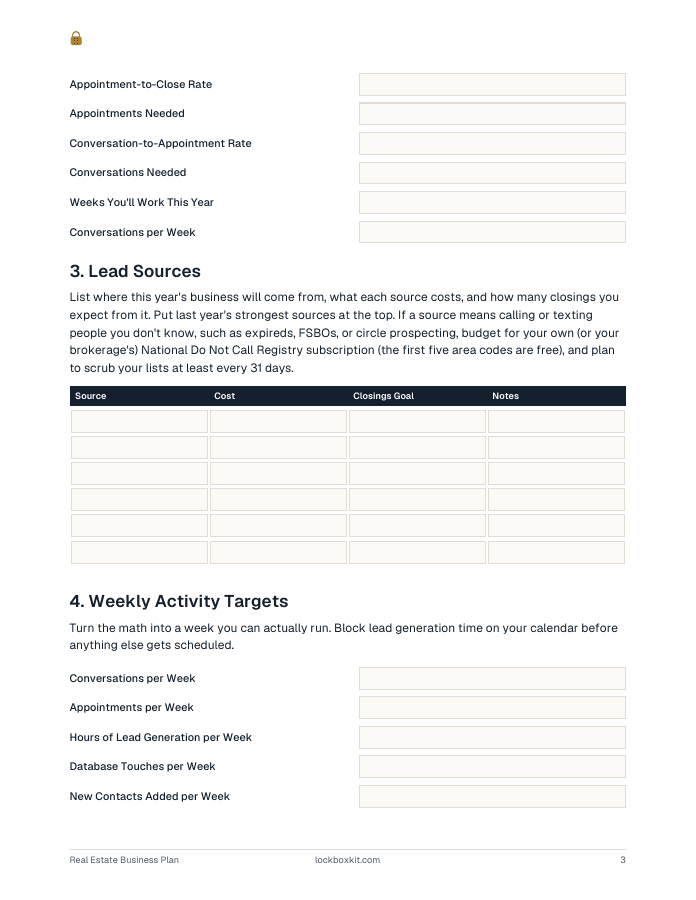
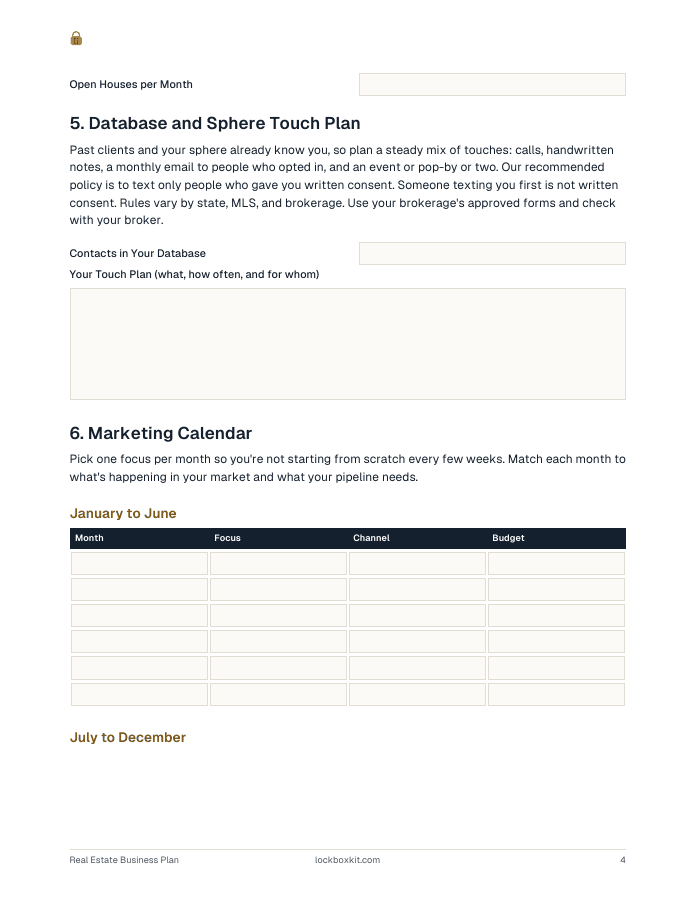
A real estate business plan template is only useful if it tells you what to do this week. A lot of plans stop at an income goal. This one keeps going: income to GCI, GCI to closings, closings to appointments, and appointments to the number of conversations you need to start every week. Then it covers your market, lead sources, marketing, budget, and the reviews that keep it honest.
What a Real Estate Business Plan Template Should Cover
Traditional business plan guides often list seven sections, such as an executive summary, business description, market analysis, organization, services, marketing and sales, and financial projections. The lists vary. For a working agent, those boil down to seven practical parts:
- Last year's numbers and your income goal
- The GCI math
- Your market
- Two or three lead sources
- Weekly activity targets
- A marketing plan and budget
- A review schedule
Fill them in order. Each part feeds the next. Here's how to create a real estate business plan, one step at a time.
Step 1: Look Back, Then Set Your Income Goal
Start with last year: closings, average GCI per closing, where each deal came from, and what you spent. If you're new, leave it blank for now.
Then write down what you need to take home this year before personal income taxes. Use your real household budget, not a round number that sounds good. List your yearly business expenses: MLS and association dues, brokerage fees, E&O insurance, CRM and software, marketing, signs and lockboxes, continuing education, phone, and mileage.
Step 2: Work the GCI Math
Note: The numbers below are a made-up example to show how the math works. They are not typical, recommended, or average figures. Replace every one with your own.
| Line | Example | How to get yours |
|---|---|---|
| Take-home goal | $70,000 | Your household budget |
| Business expenses | $18,000 | Last year's actuals |
| Needed after split | $88,000 | Add the two lines |
| Share of GCI you keep | 80% | Your split and fees |
| GCI goal | $110,000 | $88,000 divided by 0.80 |
| Avg GCI per closing | $8,500 | Your past closings, before split |
| Closings needed | 13 | $110,000 divided by $8,500, rounded up |
Now work backward from closings to activity, using your own conversion rates. Example only:
| Step | Example rate | Example result |
|---|---|---|
| Signed clients who close | 80% | 17 signed clients |
| Appointments that sign | 50% | 34 appointments |
| Conversations per appointment | 25 | 850 conversations |
| Working weeks | 50 | 17 conversations a week |
That last number is the one that matters. Seventeen real conversations a week is something you can schedule, track, and hit. An income goal is not.
What one closing is worth
Agents often ask what an agent makes on a $300,000 home. There's no set answer, because commissions aren't set by law and are fully negotiable. Use this formula with your own agreements:
- Sale price times the agreed rate, or the flat fee in your agreement = what your brokerage earns
- That amount times the share you keep = your share after the split
- Minus your expenses and taxes = what you actually keep
Made-up example: if an agreement paid your brokerage $7,200 on a $300,000 sale and you keep 80 percent, you'd get $5,760 before expenses and taxes.
Tip: If you don't know your conversion rates yet, track every conversation, appointment, signed agreement, and closing for 90 days. Then redo these tables with real numbers.
Set aside money for self-employment and income taxes from every check. Talk to a tax professional about how much.
Step 3: Define Your Market
Write down where and how you'll work:
- Area: the zip codes, towns, or neighborhoods you'll farm
- Price range and property type: for example condos, single-family, land, or small multifamily
- Transaction type: first-time buyers, move-up sellers, relocations, investors, or rentals
- Why clients should hire you: one sentence a client would repeat, like your response time or your launch plan
Compliance: Define your market by geography, price, property type, and transaction type, never by who lives somewhere or who you'd like as clients. "Young families" or "singles" is a fair housing problem. Choosing where to advertise so certain groups won't see your ads is too. Many states add protected classes beyond federal law, so check with your broker.
Step 4: Pick Two or Three Lead Sources
Spreading across ten sources means doing all of them badly. Pick two or three you'll work every week:
| Source | Main cost | Best for |
|---|---|---|
| Sphere and past clients | Time | Everyone, always |
| Open houses | Time, weekends | Newer agents |
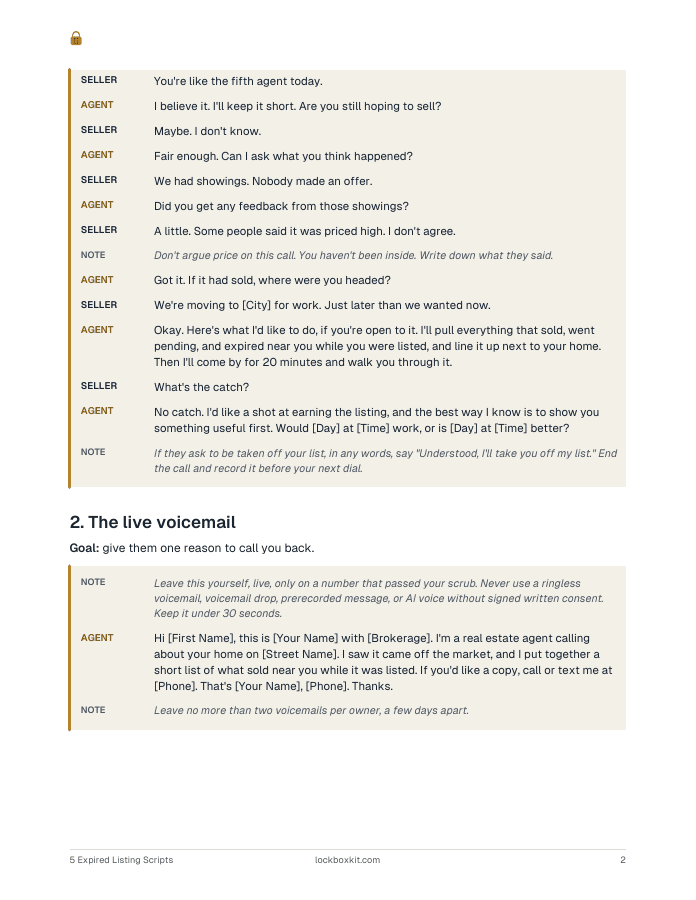
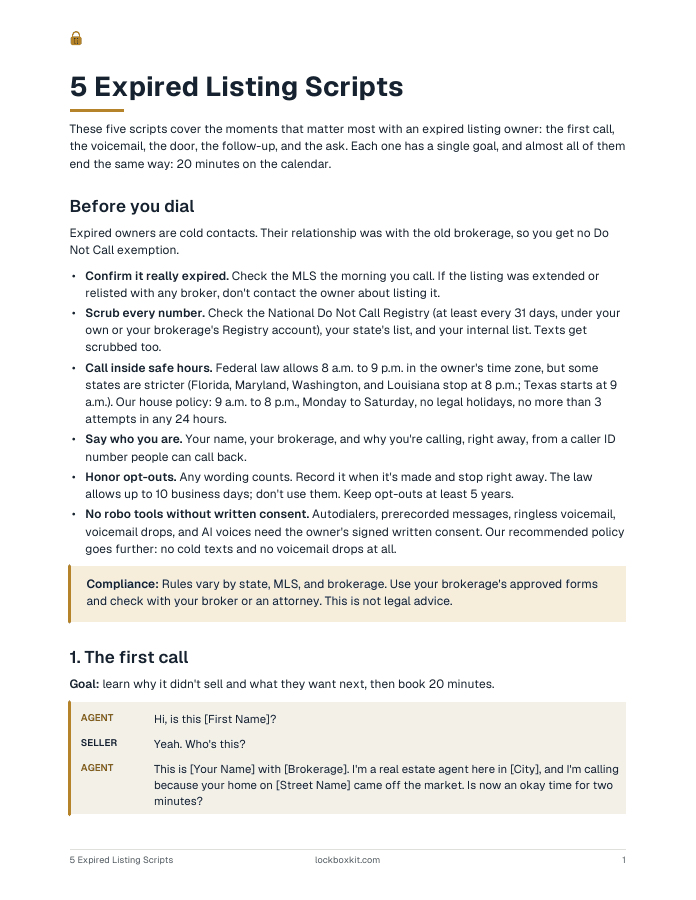
| Expired listings | Time, data | Agents who like the phone |
| FSBO sellers | Time | Agents who like the phone |
| Geographic farm | Mail budget | Patient, long-term builders |
| Online leads | Ad or referral fees | Agents with fast follow-up |
Which source is most profitable? The one with the lowest cost per closing for you. For each source, add up what it cost in money and hours, then divide by the closings it produced. Your tracker gives you the numbers after a few months.
Compliance: If your plan includes calling or texting homeowners, scrub every list against the National Do Not Call Registry at least every 31 days, plus your state list and your internal list. Call between 9 a.m. and 8 p.m., Monday to Saturday, no legal holidays, and no more than 3 attempts in any 24 hours (our house policy; the federal window is 8 a.m. to 9 p.m., and some states are stricter). Identify yourself and your brokerage, use real caller ID, and honor opt-outs right away (the legal limit is 10 business days). Autodialed, prerecorded, and AI-voice calls and texts need signed written consent. We recommend texting only people who gave you written consent. Rules vary by state, MLS, and brokerage. Use your brokerage's approved forms and check with your broker.
Step 5: Set Weekly Activity Targets
Turn your conversation number into a schedule. If you need 17 a week (using the example), that might be:
- Monday to Thursday: one hour of calls to expireds, FSBOs, or your sphere
- Friday: follow-up calls and notes on every lead from the week
- Saturday or Sunday: one open house, every visitor counted as a conversation
- Every week: a set number of sphere touches (calls, notes, or visits) from your contact list
- Every day: log conversations, appointments, and signed agreements
Block the time on your calendar like a client appointment.
Step 6: Real Estate Marketing Plan Template and Budget
Your marketing should feed the lead sources you picked, not run on its own. A simple monthly plan:
| Channel | How often | Feeds |
|---|---|---|
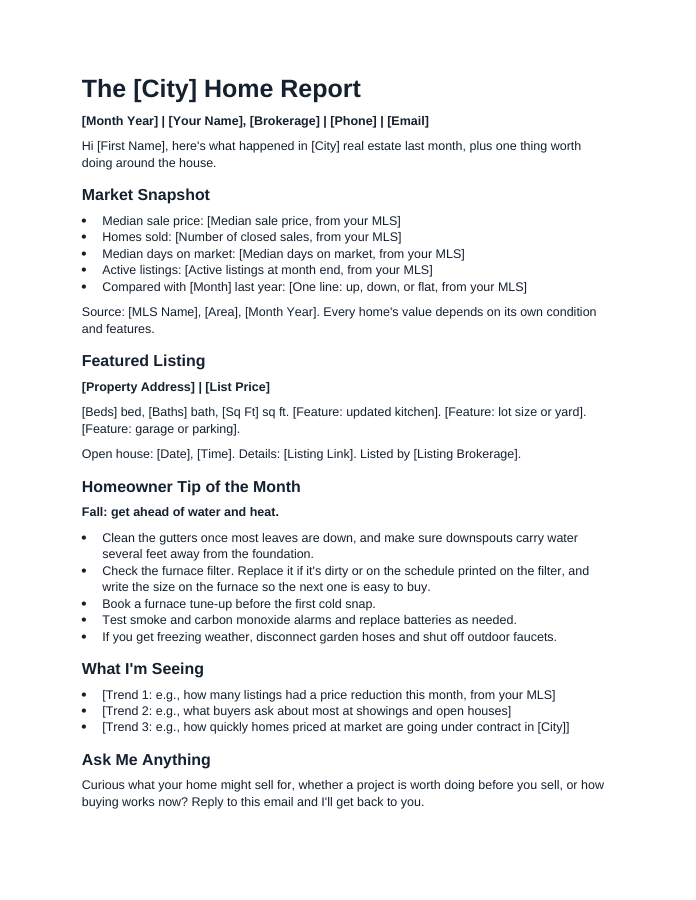
| Email newsletter | Monthly | Sphere, past clients |
| Social posts | 2 to 3 a week | Sphere |
| Farm mailer | Monthly | Geographic farm |
| Open house | 2 to 4 a month | Buyers, neighbors |
| Just listed or sold mailer | Each milestone | Nearby homeowners |
Every piece needs your brokerage name the way your state requires. If a channel isn't producing conversations after two or three months of steady effort, change it or drop it.
Then list every expense by month:
- MLS, association, and lockbox fees
- Brokerage desk fees, transaction fees, and E&O insurance
- License renewal and continuing education
- CRM, email platform, and other software
- Do Not Call Registry access (the first five area codes are free; check the Registry site for the current fee beyond that)
- Website, mailers, printing, signs, and ads
- Open house supplies
- Phone, mileage, and vehicle costs
- Client gifts, if your brokerage and state allow them
Compare the monthly total to your expected closings by month, since income arrives in lumps. Keep a cash cushion for the gap between signing a client and getting paid.
Step 7: Set Your Review Schedule
- Weekly (Monday, 15 minutes): Did you hit your conversation number? What's on the calendar?
- Monthly: Count appointments, signed clients, and pending deals. Are you on pace?
- Quarterly: Update your conversion rates with real numbers and redo the math.
Common Business Plan Mistakes
- Borrowing someone else's numbers. Another agent's conversion rates come from their market, price range, and skills. Use yours.
- Skipping the expense line. A GCI goal that ignores costs leaves you short every December.
- Too many lead sources. Two sources worked every week beat six worked when you remember.
- No weekly number. An annual goal doesn't tell you what to do on Tuesday. A conversation count does.
- Never revisiting it. Splits change, markets shift, and your skills improve. Redo the math every quarter.
Can ChatGPT Write Your Business Plan?
An AI tool can draft the structure, tighten your wording, check your arithmetic, and brainstorm marketing ideas. It can't know your income goal, your split, your market, or your conversion rates, and it may produce figures that sound right but aren't yours. Use it as a drafting helper. Check every number against your own records, and don't paste client personal information into any tool your brokerage hasn't approved.
Get the Template: PDF, Word, or Google Docs
The free real estate business plan template is a fillable PDF. It has sections for last year's numbers, your GCI goal math, a lead sources table, weekly targets, a sphere touch plan, a marketing calendar, a budget, and quarterly reviews. Fill it in on screen or print it. We don't offer a Word version. If you'd rather work in Word or Google Docs, copy the steps and tables from this page into a blank document.
Use it every January, the week you join a new brokerage, whenever your split or price range changes, and midyear if you're behind pace. The plan works if you look at it every week.
Sources
Questions agents ask
How do I create a real estate business plan?
Start with last year's numbers and the income you need. Add your yearly business expenses, divide by the share of GCI you keep after your split, and divide that by your average GCI per closing to get the closings you need. Then work backward through your own conversion rates to a weekly conversation number. Pick two or three lead sources, plan your marketing and budget, and review it every week.
What are the 7 things in a business plan?
Traditional guides often list sections like an executive summary, business description, market analysis, organization, services, marketing and sales, and financial projections, though the lists vary. For an agent, a practical seven: your income goal, your GCI math, your market, two or three lead sources, weekly activity targets, a marketing plan with a budget, and a review schedule. Keep it short enough to read every Monday.
Can ChatGPT write a business plan?
An AI tool can draft the structure, tighten your wording, double-check your math, and suggest marketing ideas. It can't know your income goal, your split, your market, or your conversion rates, and it may invent figures that sound right. Use it as a drafting helper, check every number against your own records, and don't paste client personal information into any tool your brokerage hasn't approved.
How much does an agent make off a $300,000 home?
There's no set amount. Commissions aren't set by law and are fully negotiable. Here's the math with made-up numbers: if an agreement paid the agent's brokerage $7,200 on a $300,000 sale and the agent keeps 80 percent after their split, the agent gets $5,760 before business expenses and taxes. Plug in the fee from your own agreements and your own split to plan.
What is the most profitable business in real estate?
There's no single answer. It depends on your market, skills, and capital. For a working agent, the more useful question is which lead source is most profitable for you. For each source, divide what it cost in money and hours by the closings it produced. The source with the lowest cost per closing deserves more of your week, and your tracker gives you those numbers.