A real estate newsletter template takes the hardest part out of staying in touch: deciding what to say every month. The layout below takes about an hour to fill in and is short enough that people read it. You also get a sample email to copy and 12 real estate newsletter ideas, enough for a year of issues without repeating yourself.
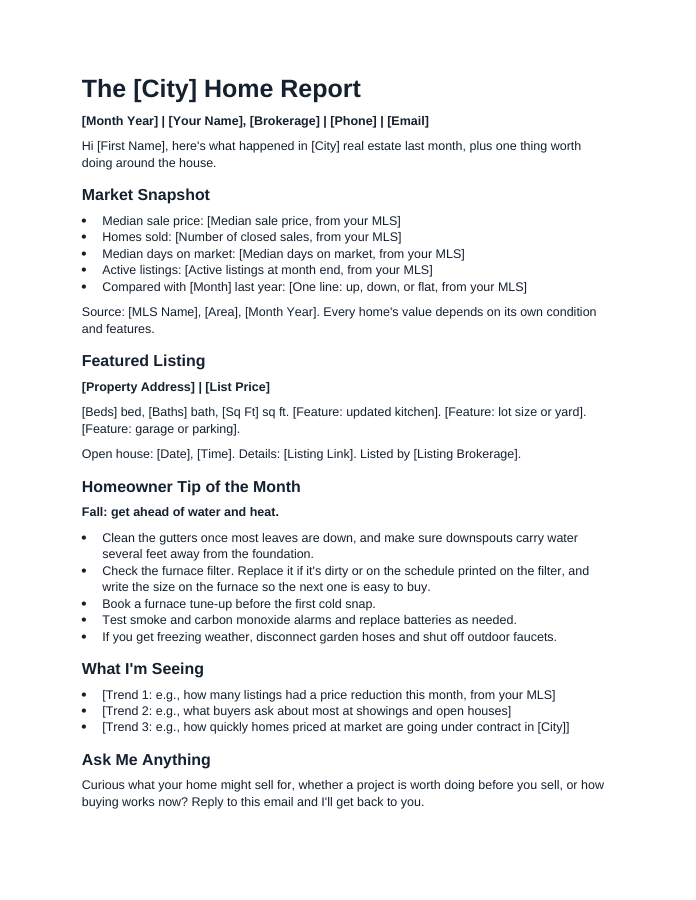
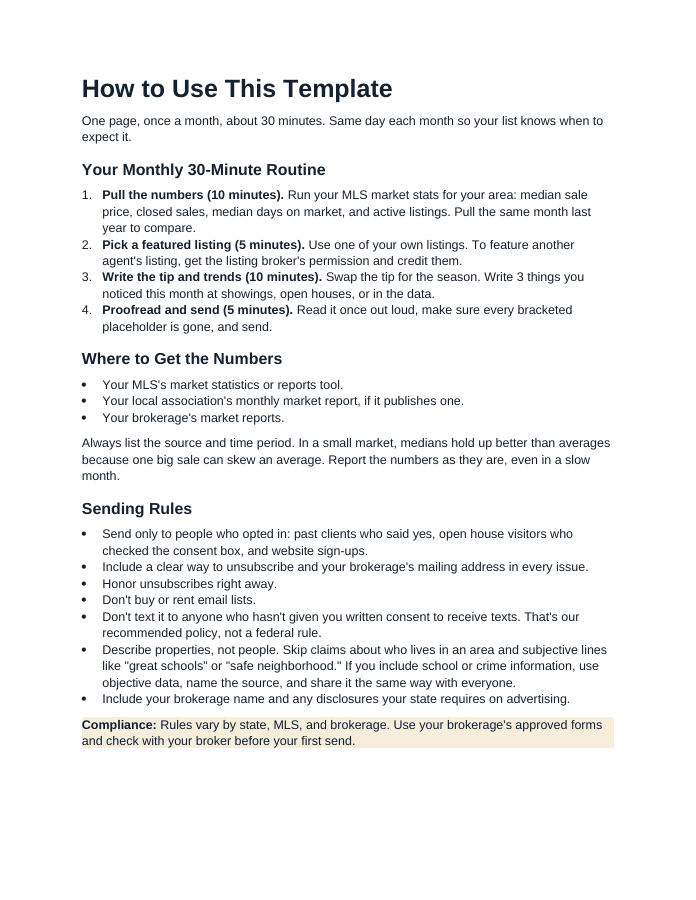
The free download is a DOCX you can edit in Word or Google Docs. It has a monthly newsletter with a market snapshot (placeholders for numbers from your MLS, with a source line), a featured listing, a homeowner tip of the month, a "What I'm Seeing" section, an "Ask Me Anything" section, and an unsubscribe footer, plus a how-to page.
What Makes a Good Real Estate Newsletter
- It arrives on schedule. Pick a day, like the second Tuesday, and keep it.
- It's short. One screen on a phone, two at most.
- It's local and sourced. Numbers come from your MLS, with the source and month.
- It's useful. Every issue gives readers something they can act on.
- It asks for one thing. One call to action per issue.
- It goes to people who said yes. Past clients, sphere, and opt-ins, not a purchased list.
The Real Estate Newsletter Template, Section by Section
Every issue follows the same order. Readers learn where to look, and you learn to write it fast.
- Subject line and preview text. Specific beats clever. "[City] home prices in [Month]" gets opened. "Monthly update" doesn't.
- Header and greeting. "The [City] Home Report," the month, your name and brokerage, then one or two sentences in your own voice.
- Market snapshot. A few numbers from your MLS for [City] or [Neighborhood]: median sale price, homes sold, median days on market, active listings, and a comparison with last year. Add the source and a line that every home's value depends on its own condition and features.
- Featured listing. Address, price, key facts, and open house time. Feature your own listings, or another brokerage's only as your MLS and brokerage rules allow, and credit the listing brokerage.
- Homeowner tip of the month. A short seasonal list readers can do this weekend.
- What I'm seeing. Two or three trends from your MLS, showings, and open houses.
- Ask me anything. One open invitation to reply with a question.
Then the footer: [Brokerage], your physical mailing address, a line reminding readers they asked to hear from you, and an easy way to unsubscribe.
Sample Real Estate Email Newsletter
Copy this, replace the brackets, and send it.
Hi [First Name],
[Two sentences in your own words about what you're seeing in the market this month.] Here's what the numbers say.
[City] market snapshot for [Month]:
- Median sale price: [Price]
- Homes sold: [Number]
- Median days on market: [Number]
Source: [MLS Name], [Month Year]
What it means: [One sentence, for example: more homes came on than sold, so buyers have a little more to choose from than last month.]
This month's tip: 5 things to check before winter
1. Replace the furnace filter.
2. Clean gutters after the leaves drop.
3. Test smoke and carbon monoxide detectors.
4. Shut off and drain outdoor spigots.
5. Check weatherstripping on exterior doors.
What I'm seeing: [A trend from your MLS or what buyers are asking about at showings this month.]
Curious what your home would sell for right now? Reply with your address and I'll put together a price opinion. No pressure, and no follow-up calls unless you ask.
Talk soon,
[Your Name]
[Brokerage]
[Phone] | [Email]
You're getting this because you asked to hear from me.
[Brokerage mailing address]
Unsubscribe
Tip: Write the next issue's opener the day you send this one, while you still remember what happened this month.
12 Real Estate Newsletter Ideas
Rotate through these and you have a full year of features:
- Seasonal maintenance list. Five quick tasks for the month ahead.
- What sold near you. Recent sales in [Neighborhood] from your MLS, within your MLS's rules on sharing sold data.
- Property tax notice explainer. When assessment notices arrive in your county and how homeowners can review theirs. Link to the county's official page.
- Buyer agreements, explained. Why buyers working with an agent now sign a written agreement before touring, what it says about pay, and that fees are not set by law and are fully negotiable. Note that state rules vary.
- How buyer-broker pay works now. Offers of compensation can't appear on NAR-affiliated MLSs, sellers can still offer it off the MLS, and buyers can ask for it in their purchase offer. Everything is negotiable.
- Local business spotlight. A shop, restaurant, or service you use, written about the business and what it offers.
- Public events calendar. Three or four events from the city's official calendar.
- Permit before you renovate. Which common projects usually need a permit in [City], with a link to the permit office.
- Client story. A recent move, told with your client's written permission and only the details they approve.
- Moving checklist. A 30-day countdown for anyone planning a move.
- Reader question. Answer one question someone asked you this month, without names.
- Year in review. Your area's numbers for the full year, from your MLS, sent in January.
Tip: When you write about an area, write about places and facts: parks, commute times, new construction, permit activity. Never describe who lives there. If you mention schools, stick to objective, sourced facts and skip claims like "great schools." Give every reader the same information.
Subject Lines That Get Opened
Specific and local wins. Rotate through these, swapping in your own area and month:
- What homes sold for in [City] last month
- [Neighborhood] prices: [Month] update
- 5 things to do before your first freeze
- Your property tax notice, explained
- Who pays the buyer's agent now? (2026)
- The question I got asked most this month
- [City] in [Year]: the numbers
Keep subject lines under about 50 characters so they don't get cut off on a phone, and make sure the email delivers what the subject promises.
How to Send It: Email Platform, Word, or Print
- Email platform. The best home for a monthly newsletter. It stores your list, adds the unsubscribe link, removes people who opt out, and shows who opened. Paste the template sections into its editor once and reuse that design every month.
- Word or Google Docs. Good for drafting and for a printed version. The DOCX download opens in both.
- Print. Worth adding for a geographic farm or past clients who prefer mail. Use the same content as the email so you only write it once.
To set it up: pick a platform, import only contacts who said yes (tagged by how they joined), build the template with your brokerage name and mailing address in the footer, send yourself a test, and schedule the same day each month.
Real Estate Email Newsletter Rules to Follow
What the law covers: commercial email falls under the federal CAN-SPAM Act. Among other things, it requires accurate sender and subject information, a valid physical postal address (a street address or a registered PO box or private mailbox), and a working way to opt out, with opt-outs honored within 10 business days. Our recommended house policy goes further:
- Send only to people who opted in or asked to hear from you
- Use an accurate From name and a subject line that matches the content
- Include your brokerage name and a physical mailing address
- Include a working unsubscribe link in every issue
- Remove anyone who unsubscribes the same day, and keep a record
- Follow your brokerage's rules for advertising listings and sales
- Get written permission before featuring a client's home or story
Compliance: Your brokerage name belongs on every issue, and buyer-agreement and compensation rules can differ by state. Rules vary by state, MLS, and brokerage. Use your brokerage's approved forms and check with your broker. This is not legal advice.
Building the List
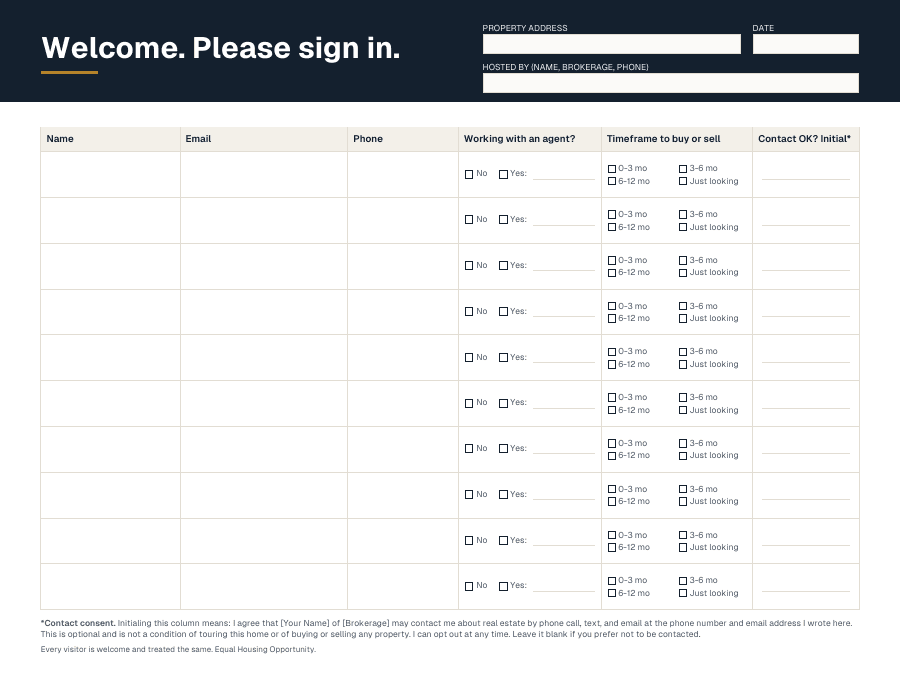
Start with the people who already know you: past clients, friends, and your sphere who have said yes to hearing from you. Then add website signups, open house visitors who checked the email consent box, and anyone who asks to be added. Visitors who only signed in to see a home didn't ask for a monthly email, so send them a follow-up and invite them to subscribe. Keep the list in one place, tag each contact with how they joined, and clean out bounced addresses every quarter.
When to Use It
- As your monthly touch with past clients and your sphere
- As the long-term follow-up for open house visitors who opted in
- As a printed mailer for a geographic farm, using the same content
- When you want a reason to reach out that isn't "Are you thinking of selling?"
Block one hour on the same day each month to write it. Pull the market numbers first, pick the feature from the list, and the rest falls into place.
Sources
- NAR, Settlement FAQs
- NAR, Policy Statement 8.11: No Offers of Compensation in MLS
- NAR, Policy Statement 8.13: Written Buyer Agreements
- NAR, FAQs on Steering, Crime and Schools (June 2026)
- NAR, 2026 Code of Ethics and Standards of Practice
- 42 U.S.C. 3604, Fair Housing Act (Cornell LII)
- FTC, CAN-SPAM Act: A Compliance Guide for Business
Questions agents ask
What makes a good real estate newsletter?
It shows up on the same schedule, it's short, and every issue gives the reader something useful: local numbers from your MLS, a homeowner tip, or a straight answer to a question people are asking. It sounds like you, has one clear call to action, and goes only to people who asked to hear from you. A reader should be able to finish it in about two minutes.
Is there a free newsletter template?
Yes. Ours is a free DOCX with sections for a market snapshot, a featured listing, a homeowner tip, what you're seeing in the market, and an invitation to ask questions, plus a how-to page. Email platforms and design tools such as Canva also offer free templates. Whichever you use, keep the same layout every month so readers learn where to look.
What is the best newsletter for real estate agents?
The best one is a monthly email you can keep sending. For most agents that means a short, local issue: a few market numbers from your MLS, one useful tip, a note on what you're seeing, and one question to reply to. Send it from an email platform that handles unsubscribes for you, and add a printed version for your farm once the email habit sticks.
What are some catchy phrases for real estate?
In a newsletter, specific beats catchy. Subject lines like "What homes sold for in [City] last month" or "Your property tax notice, explained" get opened because they promise something useful. Skip worn-out listing words and any phrase about who a home or neighborhood suits. If a line would fit any agent in any town, rewrite it around a local fact.
What are some funny real estate slogans?
Humor works best when it's about the house, the weather, or you, never about people or neighborhoods. A few subject lines in that spirit: "Your gutters called. They want a word." "The furnace filter you forgot about." "Yes, this one has actual numbers." Keep the joke to the subject line or the opener, and make the rest of the issue useful.