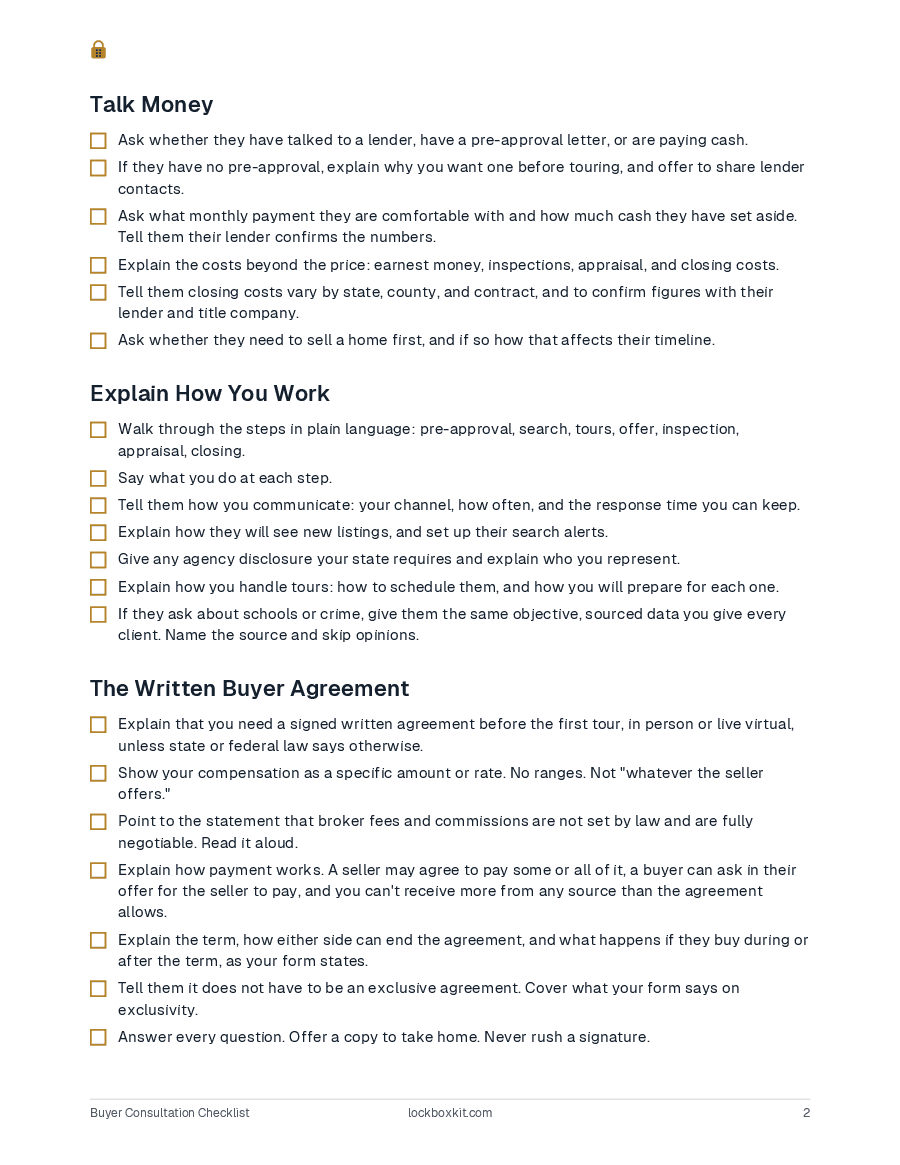
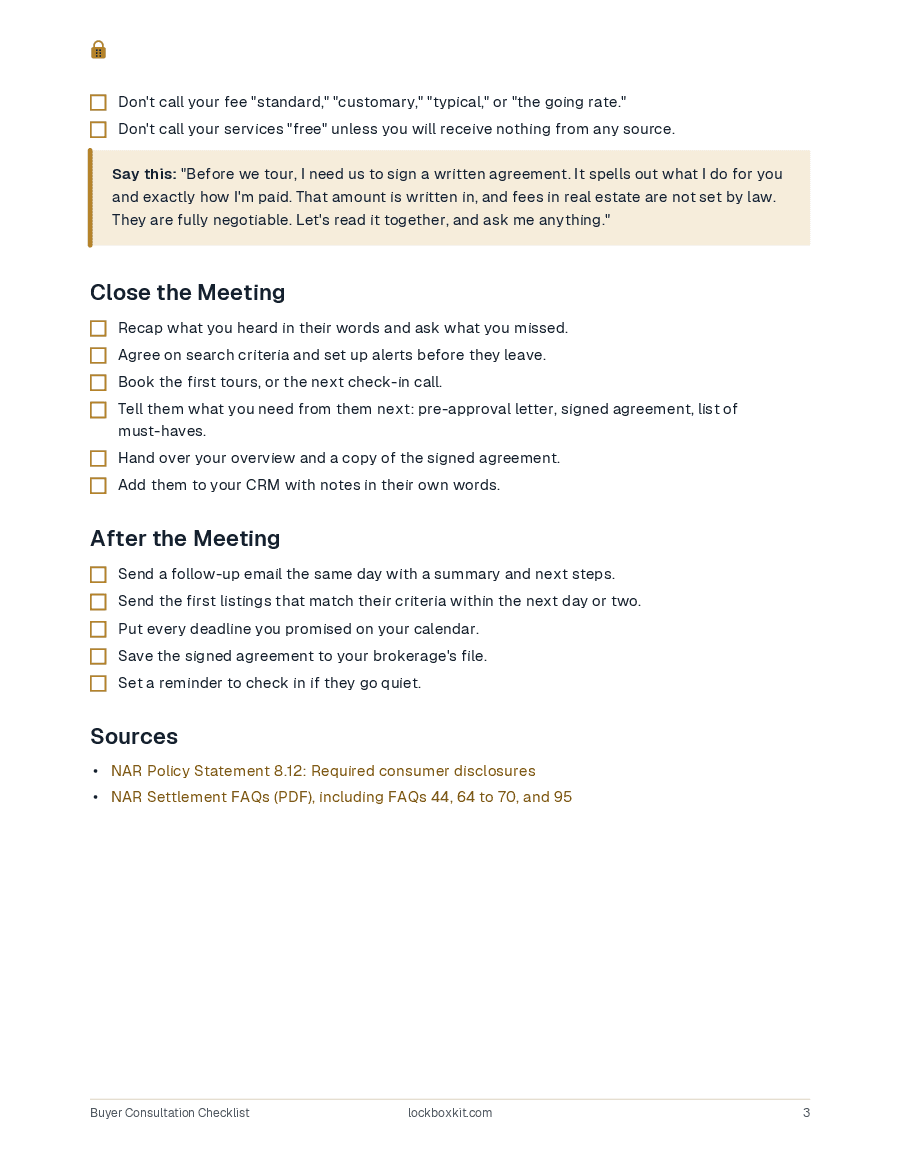
Hold a buyer consultation before the first tour, in person or by video, and plan on 45 minutes to an hour. You'll cover seven steps in the order below, from setting expectations to agreeing on next steps.
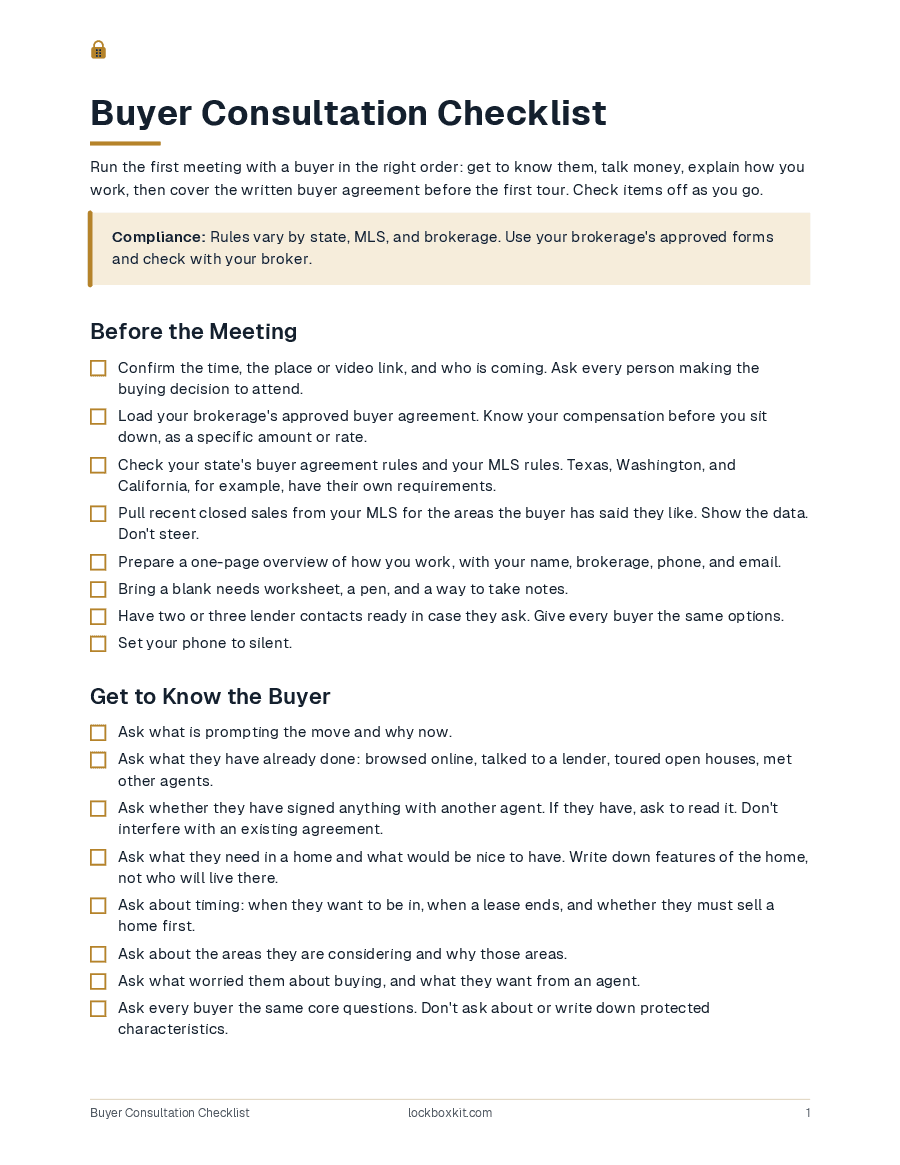
The written buyer agreement belongs late in the meeting, at step 6 of 7, after you've explained your services and before you show a single home. The free checklist follows the same order, from prep to follow-up.
The Buyer Consultation Agenda, in Order
- Rapport and expectations. Say what you will cover and how long it will take. Ask what they hope to get out of the meeting.
- Their story. Why they're moving, why now, and what they've already done.
- The home and the plan. Must-haves, nice-to-haves, areas, timing, and whether they need to sell first.
- Money. Pre-approval, monthly comfort, cash for the purchase, and costs beyond the price.
- How you work. The steps from search to closing, what you do at each one, and how you communicate.
- The written agreement and your compensation. Cover it plainly, then give them time to read it.
- Next steps. Search criteria, alerts, the first tours, and what you need from them.
Open with a short script so the buyer knows the plan:
Thanks for meeting with me, [First Name]. Here's what I'd like to do today. First I want to hear what you're looking for and your timeline. Then we'll talk about what you're comfortable spending. After that I'll walk you through how I work and the written agreement we'd sign before we tour anything. We'll finish with next steps. Does that sound good?
Sounds good.
Great. Before we dig in, what made you decide to start looking now?
Then stop talking. Take notes in their words.
Before the Meeting: What to Prepare
- Confirm the time, the place or video link, and who is coming. Ask every person making the buying decision to attend.
- Load your brokerage's approved buyer agreement, and know your compensation as a specific amount or rate before you sit down.
- Check your state's rules on buyer agreements and your MLS rules.
- Pull recent closed sales from your MLS for the areas the buyer has said they like. Show the data. Don't steer.
- Prepare a one-page overview of how you work, with your name, brokerage, phone, and email.
- Have two or three lender contacts ready in case they ask, and disclose any business relationship with them as your brokerage requires. Give every buyer the same names.
Buyer Consultation Questions to Ask
Write the answers down in the buyer's own words. Record features of the home and the area, not who will live there. A must-have is something they'd walk away from a home over. Everything else is a nice-to-have.
Their situation
- What made you decide to start looking now?
- Have you worked with an agent before, or signed anything with one?
- What have you done so far: browsed online, toured open houses, talked to a lender?
The home
- What must the home have? What would be nice to have?
- What would make you walk away from a home?
- Which areas are you considering, and what draws you to them?
Timing
- When do you want to be in?
- Is there a lease end date or a home you need to sell first?
Money
- Have you talked to a lender, or are you paying cash?
- What monthly payment feels comfortable, not just what you could be approved for?
- How much cash have you set aside for the down payment and closing costs?
When a buyer says they've signed with another agent, ask to read the agreement. Don't interfere with it.
How to Explain How You Work
Most buyers don't know the steps, so walk them through it in plain words: pre-approval, the search, tours, the offer, inspections, the appraisal, and closing. For each one, say what you do and what you need from them.
Then say how you'll communicate, and promise only what you can keep: your channel, how fast you reply, and how often you'll send search updates, even when nothing new came up. Give any agency disclosure your state requires and say plainly who you represent.
Here's how this will go. First we get you pre-approved, then I set up your search, then we tour, then we write an offer. I'll reply within [X] hours, and every [Day] I'll send you an update, even if nothing new came up. How do you like to communicate?
Text is best. I'm in meetings most of the day.
Let them answer, then write down how they like to communicate.
How to Cover the Written Buyer Agreement
Since August 17, 2024, offers of compensation to buyer brokers can't appear on MLSs that follow NAR's rules. MLS participants and subscribers working with a buyer need a written agreement before the buyer tours a home, in person or live virtual, unless state or federal law says otherwise. A buyer who only visits an open house you're hosting for the seller doesn't need one yet. Once you start touring homes with them, you need one, unless state or federal law says otherwise. Bring it up in the consultation, not in the driveway of the first showing.
The agreement and the rules around it come down to this:
- It states your compensation as a specific, conspicuous amount or rate. No ranges, and not "whatever the seller offers."
- It says conspicuously that broker fees and commissions are not set by law and are fully negotiable.
- You can't receive more from any source than the agreement allows.
- It should also cover how long it lasts and how either side can end it.
It doesn't have to be exclusive. States such as Texas, Washington, and California add their own requirements, so check yours.
Before we tour anything, I need us to sign a written agreement. It spells out what I do for you and exactly how I'm paid. The amount is written in. Fees in real estate are not set by law, and they're fully negotiable, so let's read it together.
What if the seller doesn't pay your fee?
A seller can offer to pay some or all of it, and we can ask for that in your offer, but they don't have to. Depending on the agreement, you may owe whatever the seller doesn't cover. I'll tell you what's offered on each home before you decide.
Pause. Offer a copy to take home. Never rush the signature.
If a buyer hesitates:
I'd like to think about it before I sign anything.
That's fine. Take a copy home and read it. Which part should I go over again? If something in it doesn't work for you, tell me. The terms are negotiable.
Offer to keep talking about their search, but don't tour homes together until an agreement is signed, if the MLS rules apply to you.
If they ask about exclusivity, or say they already have an agent:
Do I have to sign an exclusive agreement?
It doesn't have to be exclusive. Let's look at what this form says about that and talk through the terms.
I'm already working with another agent.
Thanks for telling me. Can I read what you signed? I won't get in the way of an existing agreement.
Cover what your brokerage's form says on exclusivity. Don't promise terms the form doesn't have.
A seller can still offer to pay a buyer's broker off the MLS, and a buyer can ask for it in their offer. Seller concessions, like help with closing costs, can still appear on the MLS if your local MLS allows it, but they can't be conditioned on paying a buyer broker. Whatever is paid, the total you receive from all sources can't exceed what the agreement allows.
Compliance: Never call your fee "standard," "customary," "typical," or "the going rate." Don't call your services "free" unless you will receive nothing from any source. Rules vary by state, MLS, and brokerage. Use your brokerage's approved forms and check with your broker.
How to Talk About Money
Ask about financing early. The answer sets your search range. A buyer without a pre-approval needs to hear why you want one before touring, so offer lender contacts. Explain the difference: a pre-qualification is an estimate based on what the buyer tells a lender, and a pre-approval means the lender has reviewed their income, credit, and assets.
What monthly payment feels comfortable to you? Not the most a lender would approve, the number you'd be happy to pay every month.
Probably around [$X].
Got it. Have you talked to a lender yet, or would a few names help?
Write the number down. It can differ from the most a lender would approve, and their lender confirms what they can actually get.
Explain the costs beyond the price: earnest money, inspections, the appraisal, and closing costs. Their cash isn't only the down payment. Closing costs come out of it too, and so can any part of your fee the seller doesn't cover, depending on your agreement. Closing costs vary by state, county, and contract, so tell the buyer to confirm figures with their lender and their title company. Don't quote numbers you can't back up.
Fair Housing at the Consultation
Describe the property, never the people. Don't state a preference for or against any protected class, and don't steer buyers by area. Ask every buyer the same questions, in the same way.
If a buyer asks about schools or crime, give them the same objective, sourced data you give every client, name the source, and leave out your opinions. Don't tell them it's illegal to discuss, and don't send them elsewhere to find out.
Leave-Behinds and Follow-Up
- Before they leave, hand over your one-page overview and a copy of the agreement, signed, or to take home if they want time.
- Give them the next steps in writing, with dates.
- Pass along your lender contact sheet if they asked for one.
- Send a follow-up email the same day with a summary and next steps.
- Set up their search alerts and send the first matching listings within a day or two.
- Put every deadline you promised on your calendar.
- Save the signed agreement to your brokerage's file.
- Add the buyer to your CRM with notes in their own words.
If your buyer came from an open house, see the open house checklist for when a visitor becomes a buyer relationship. Once they're under contract, switch to the buyer side of the transaction checklist.
What Buyers Should Expect From a Buyer Consultation
If you're a buyer, ask before you sign: how will you be paid, what could I owe, how long does the agreement last, and how do I end it? You can negotiate the terms. With an MLS agent, expect a written agreement before your first tour, unless your state's rules say otherwise.
Buyer Consultation Mistakes to Avoid
- Letting the buyer hear about your fee for the first time at the first showing.
- Doing most of the talking. If you've been explaining for a while, ask a question.
- Skipping the money questions. A search with no budget sends buyers to homes they can't afford.
- Letting the buyer leave with no next step on the calendar. Book the first tour or the next call before they stand up.
Use a Deck to Run the Meeting
The Listing Appointment Kit includes an 18-slide buyer consultation deck, built around the written buyer agreement. It walks buyers through your services, how your fee works, and how it might be paid. After that it covers financing, touring, offers, and closing.
Every slide has speaker notes, and the deck is an editable PPTX for PowerPoint, Google Slides, Keynote, or Canva, plus a PDF. It doesn't include the buyer agreement itself. Use your brokerage's form for that. The deck covers the agreement before financing, so reorder the slides if you'd rather talk money first. See what's in the kit. If you list homes too, the kit also has a 24-slide listing presentation, and the listing presentation template page has a free six-slide starter deck.
Download the free checklist and bring it to your next buyer meeting.
Questions agents ask
What is a buyer consultation in real estate?
A buyer consultation is a structured first meeting between a buyer's agent and a buyer, held before any home tours. The agent learns what the buyer needs, when they want to move, and what they can spend. The agent also explains how buying works, what services they provide, and how they're paid, then covers the written buyer agreement. It can happen in person or by video.
What questions should I ask in a buyer consultation?
Start with why they're moving and when. Then ask what they must have and would like to have in a home, which areas they're considering, whether they've talked to a lender, whether they need to sell a home first, and whether they've signed anything with another agent. Ask every buyer the same core questions, and write down features of the home, not who will live there.
How long should a buyer consultation take?
NAR's rules don't set a length. Plan on 45 minutes to an hour as a starting point, and longer if the buyer is new to the process or has a lot of questions. Never rush the agreement.
Do I need a signed agreement before showing homes?
If you're an MLS participant or subscriber working with a buyer, NAR's MLS rules call for a written agreement before the buyer tours a home, in person or live virtual, unless that conflicts with state or federal law. It must state your compensation as a specific amount or rate and say conspicuously that broker fees and commissions are not set by law and are fully negotiable. Rules vary by state, MLS, and brokerage. Use your brokerage's approved forms and check with your broker.
What should I bring to a buyer consultation?
Bring your brokerage's approved buyer agreement, a one-page overview of how you work, a blank needs worksheet, and recent closed sales from your MLS for the areas the buyer has named.