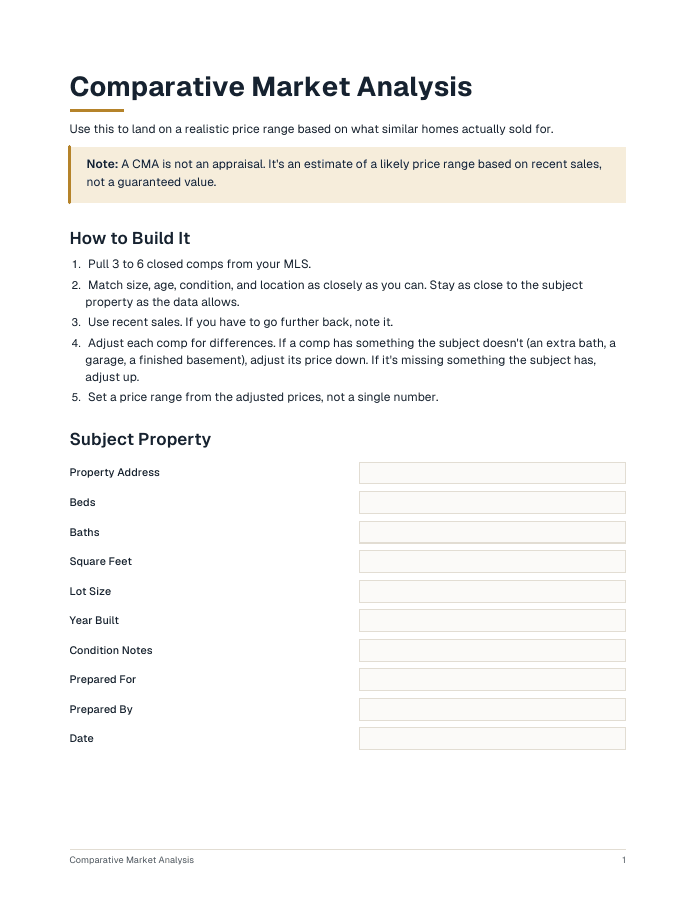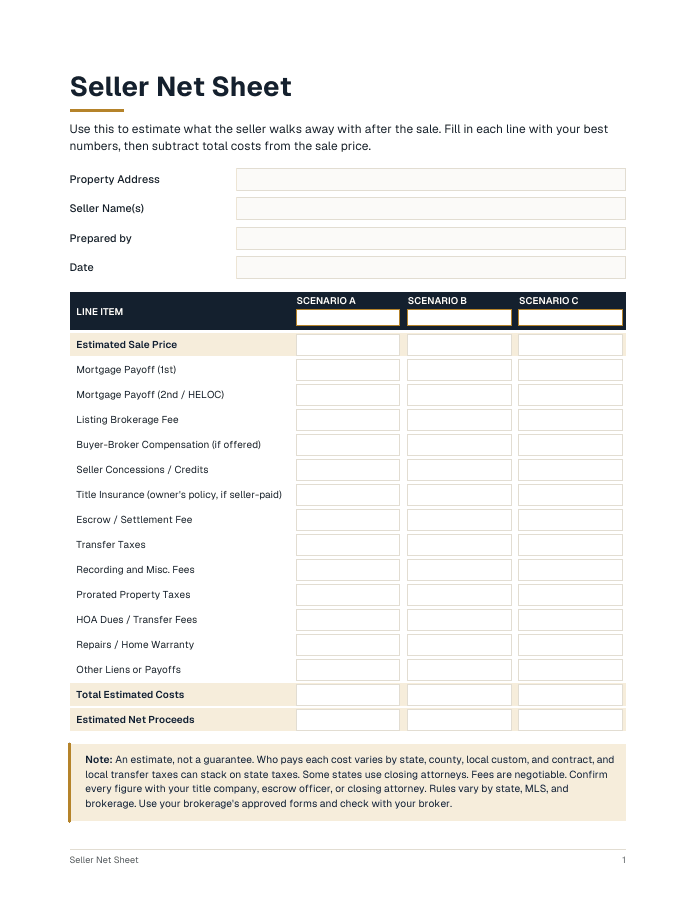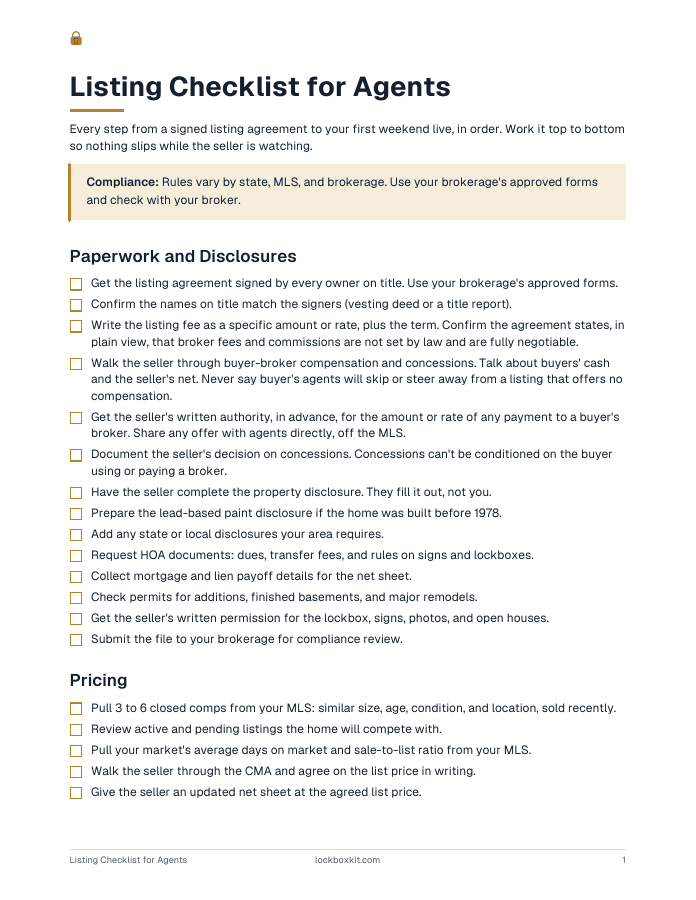

A listing presentation is the meeting where you show a seller how you'll price, prepare, market, and sell their home, and then ask for the listing. The old version, a walk through your awards plus a pie chart of the commission split, doesn't fit anymore. Since the NAR settlement practice changes took effect on August 17, 2024, sellers expect straight answers about what they pay, who they pay, and what they get. Below: a slide-by-slide listing presentation template, how to prepare, what to cut, and talk tracks for pricing and compensation.
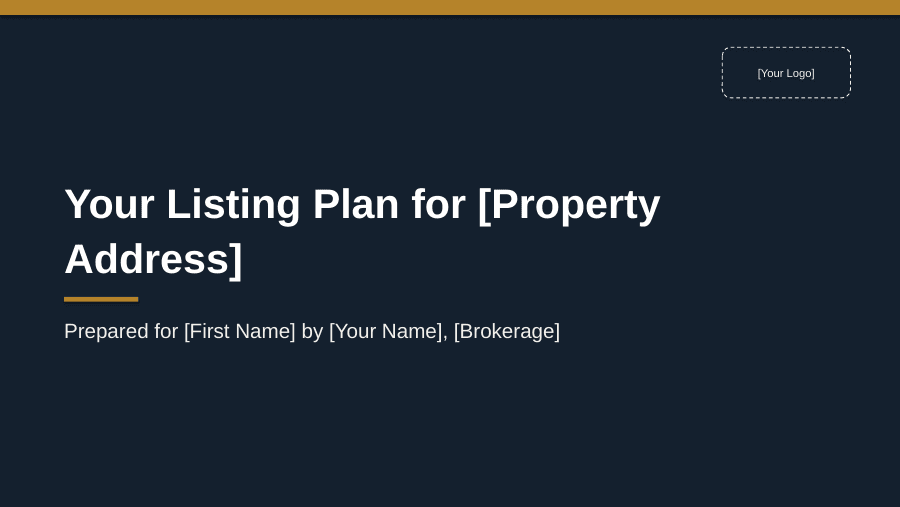
The free starter deck is a PPTX pulled from The Listing Appointment Kit (cover, about you, pricing strategy, marketing plan, buyer-broker compensation options, next steps) with the talk track in the speaker notes. It's editable in PowerPoint, Google Slides, Keynote, or Canva.
What Is a Listing Presentation?
It's a sales meeting where the seller makes the decisions. A good real estate listing presentation settles four things:
- Whether they hire you.
- The list price, or at least the range and a date to review it.
- The prep and launch plan.
- The terms: your fee, the listing period, how the home will be marketed, and the seller's decision on buyer-broker compensation.
Every slide should serve one of those.
What Changed for Listing Presentations Since 2024
- Offers of compensation to buyer brokers can't appear on the MLS. No fields, no remarks, no one-click links. A seller can still offer to pay the buyer's broker off the MLS, and a buyer can ask in their purchase offer for the seller to pay their broker.
- Seller concessions are a separate thing. Help with the buyer's closing costs can still appear on the MLS if your MLS allows it, but a concession can't be conditioned on the buyer using or paying a broker.
- Written authority comes first. Before you offer or pay anything to a buyer's broker, you need the seller's written authority, in advance, showing the amount or rate. Your listing agreement must also say, conspicuously, that broker fees and commissions are not set by law and are fully negotiable.
- Buyers sign before touring. MLS agents working with a buyer need a written agreement before the first tour, in person or live virtual. It must state the agent's compensation as a specific amount or rate (no ranges, not "whatever the seller offers"), and the agent can't accept more from any source. Some states add their own rules. Texas requires an agreement before showing a home, Washington requires a services agreement, and California requires one by the time of the buyer's offer.
- Listing options depend on your MLS. Office exclusives and delayed marketing come from NAR's 2025 Multiple Listing Options for Sellers policy, but whether and how they work is up to your local MLS.
Compliance: Rules vary by state, MLS, and brokerage. Use your brokerage's approved forms and check with your broker.
How to Prepare for a Listing Appointment
Most of the work happens before you knock on the door.
- Call the seller first. Ask why they're moving, by when, what they need to net, who else is part of the decision, and who else they're interviewing.
- Pull the tax record, prior MLS history, and HOA details.
- Build the CMA: solds, pendings, actives, and expireds.
- Run a seller net sheet at three price points.
- Send a short pre-listing packet: your process, what to expect, and what to have ready.
- Refresh the market numbers from your MLS the morning of.
- Bring your brokerage's listing agreement, the disclosures your state requires, and the form you use for the seller's compensation decision.
- Ask everyone involved in the decision to be at the table.
- Practice the pricing and fee sections out loud.
Listing Presentation Template: The Slide-by-Slide Outline
Each slide has one job. Fifteen slides and about 45 minutes leave room for the seller to talk.
- Cover. [Property Address], prepared for [Seller Name] by [Your Name], [Brokerage], [Date].
- Your goals and today's decisions. Their timeline, the net they need, and where they're going next, in their words. Then the decisions you'll make together today.
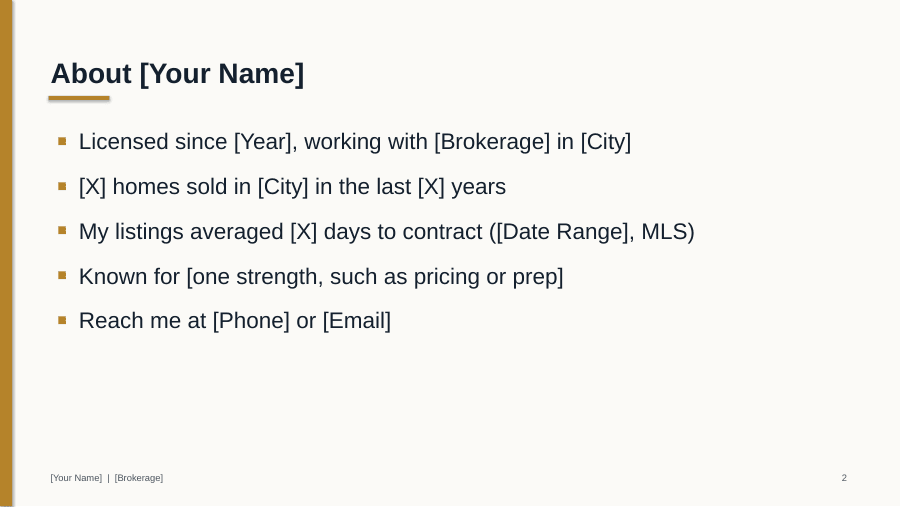
- About me. One slide. Your recent results pulled from your MLS history, and reviews you have permission to share.
- How buyers will find this home. Search portals, buyer agents, signs, and your own database. Show the price bands buyers use when they search.
- Your local market. Active, pending, sold, and expired counts for [Neighborhood] from your MLS, plus average days on market.
- Comparable sales. Three to six recent sales, with your adjustments and why.
- The competition. Current actives at similar prices. These are the homes buyers will tour the same weekend.
- Pricing recommendation. A range, your recommended list price, and the reasoning.
- Estimated net proceeds. A seller net sheet at the low, middle, and high end of the range.
- Prep plan. Repairs, cleaning, staging, and the photo date, with who handles each item.
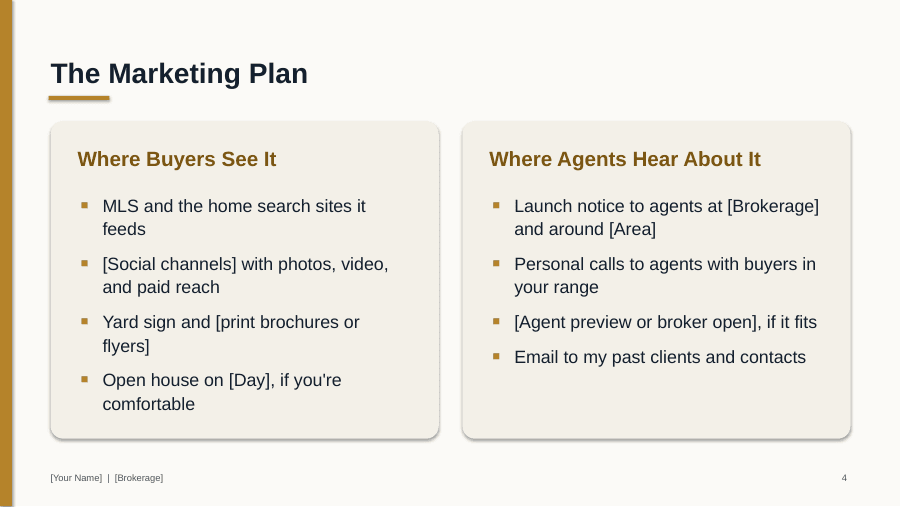
- Marketing and launch. Photos and media, MLS and portal exposure, your own channels, open houses if the seller wants them, and the first seven days with dates.
- Showings and updates. How showings get booked, how feedback reaches them, and when you'll report in.
- Your fee and what it covers. The services, the fee, and the terms, stated plainly.
- The buyer-broker compensation decision. Their options, the trade-offs, and space to record what they choose.
- Next steps. Paperwork, disclosures, prep dates, and the target launch date.
Tip: Put the seller's name and address in every slide header. It's a small detail that makes a template feel built for them.
Example: How the Appointment Flows
Here's an example order for an in-person appointment:
- Walk the home first. Let the seller lead. Take notes on condition and updates.
- Sit where you can both see the screen.
- Confirm their goals. Read back what they told you on the call and ask what's changed.
- Market, competition, comps, and price. Slides 5 through 8. Let them react to each one.
- Net sheet. Turn the price into dollars in their pocket.
- The plan. Prep, marketing, showings, and updates.
- Terms. Your fee, then the compensation decision.
- Ask for the decision. If they're ready, sign. If not, agree on when they'll decide.
How to Handle the Pricing Conversation
Pricing goes better when the seller reaches the number with you instead of receiving it from you.
- Start with the competition slide. Ask which active listing they'd buy if they were shopping today.
- Walk through each comparable sale and the adjustments. Let them push back.
- Show the range. Then give your recommended list price and why.
- Move straight to the net sheet so the conversation is about dollars, not pride.
- If they want a higher number, agree now on a review date and the price change you'll make if showings or offers don't come.
Another agent told us we could get [Higher Price].
That's worth looking at. Can we pull up the sales that number is based on?
They didn't really show us any.
Then let's look at these together. If there's a sale I missed that supports [Higher Price], I want to see it too.
Go comp by comp. Do not criticize the other agent.
Based on what's actually sold, I'd list at [List Price]. If you'd like to test a higher number, let's agree now on what we'll do after the first two weekends.
How to Handle the Compensation Conversation
Presenting your fee
State your fee, what it includes, and the terms. Then stop talking and let them respond. Your fee is your own business decision and it's fully negotiable, and your listing agreement has to say that broker fees aren't set by law. Never call any rate "standard," "typical," or "the going rate," never quote what other agents charge, and never discuss your rates with other brokerages.
The buyer-broker compensation decision
The seller has three main options, and none is right for every home:
| Option | What it means | Watch for |
|---|---|---|
| Offer buyer-broker pay | Seller authorizes an amount or rate, shared off the MLS | Written authority first |
| Offer concessions | A credit toward the buyer's costs | MLS only if allowed; not tied to a broker |
| Decide offer by offer | Seller responds to requests in offers | Buyers can ask in any offer |
Talk through the trade-offs for their home. Offering something up front may make it easier for buyers who are short on cash to write an offer. Waiting keeps flexibility, but requests will show up in offers. You can explain buyer costs and how buyers might respond. What you can't do is tell the seller that buyer agents will skip or steer buyers away from their home if they offer nothing. NAR's settlement FAQ says listing brokers must not say that.
One decision is yours to make: whether to offer anything toward the buyer's agent fee.
Don't buyers pay their own agent now?
Buyers working with an agent sign an agreement that spells out what their agent will be paid. Some buyers will ask you to cover part or all of that in their offer. You can offer something up front, offer a credit toward their closing costs, or decide when offers come in.
What do you recommend?
Let's look at who's likely to buy this home and how much cash they'll need. Then you decide, and we'll put your decision in writing, with the exact amount if you choose to offer one.
Compliance: This is not legal advice. Get the seller's written authority, with the amount or rate, before offering or paying anything to a buyer's broker. Rules vary by state, MLS, and brokerage. Use your brokerage's approved forms and check with your broker.
What to Cut From Your Listing Presentation
Cut these, or move them to the pre-listing packet:
- More than one slide about you or your team
- Brokerage history and office photos
- National market headlines and news clips
- Generic claims like "maximum exposure" with nothing specific behind them
- Any chart showing a commission "split" with the buyer's agent
- Marketing tools the seller won't see or benefit from
- Slides you skip every time anyway
Listing Presentation PDF or Live Slides?
Use both. Present the slides in person on a tablet, laptop, or TV, and keep each slide to one point, a big number, and a few words. Then send the listing presentation PDF the same day so the seller can share it with anyone else in the decision. Keep one master file and update the market slide monthly.
After the Appointment
- Send a thank-you and the PDF the same day.
- Answer any open questions in writing.
- If they signed: submit the paperwork to your brokerage and book prep and photo dates.
- If they didn't: confirm the date they'll decide and follow up then.
- Add answers to any new questions to your deck before the next appointment.
Sources
- NAR Policy Statement 8.11: No offers of compensation in the MLS
- NAR Policy Statement 8.12: Required consumer disclosures
- NAR Policy Statement 8.13: Written buyer agreements
- NAR Settlement FAQs (buyer requests in offers)
- NAR Settlement FAQ PDF (concessions and steering statements)
- NAR Multiple Listing Options for Sellers
Questions agents ask
What is a listing presentation?
It's the meeting where you show a seller how you would price, prepare, market, and sell their home, and ask for the listing. A good one is a conversation built on the seller's goals and your MLS data, not a tour of your awards. It should end with decisions: the list price, the prep plan, the launch date, your fee, and the seller's choice on buyer-broker compensation.
Can you give an example of a listing presentation?
Here's a simple flow. Walk the home, sit down together, and confirm the seller's goals. Review the market and the competition, walk through the comps, and land on a price range. Show the net sheet, explain the prep and marketing plan, present your fee, cover the buyer-broker compensation decision, and agree on next steps. The slide-by-slide outline on this page follows that order.
How many homes does an agent need to sell to make $200,000 a year?
There's no single answer, because every fee is negotiated and splits and costs differ. Work backward with your own numbers: your average sale price times the average fee you actually earn per side gives gross commission per closing. Apply your brokerage split, subtract per-deal costs, then divide $200,000 plus your yearly business expenses by that net. Your appointment-to-listing rate tells you how many presentations that takes.
What are the four types of presentations?
Lists vary, but most group presentations by purpose: to inform, to persuade, to instruct or demonstrate, and to inspire. A listing presentation is persuasive, but it persuades best by informing. Show the seller the data, the plan, and their options, then let the decision follow from the facts instead of from pressure. Sellers trust a recommendation more when they can see how you reached it.
What are the 5 P's of presentation?
There isn't one official list, and versions vary. Most stress planning, preparing, and practicing before you present. For a listing appointment, plan around what the seller told you on the pre-listing call, prepare your CMA and net sheet with fresh MLS data, practice the pricing and fee talk tracks out loud, present it as a conversation, and follow up the same day.
What is the 7-7-7 rule for presentations?
It's a slide-writing rule of thumb, and you'll see different versions. Most limit how much text goes on a slide, often to about seven lines with about seven words per line. The idea fits listing decks well: one point per slide, large numbers, few words. Put the detail in your talk track and in the PDF you leave with the seller.