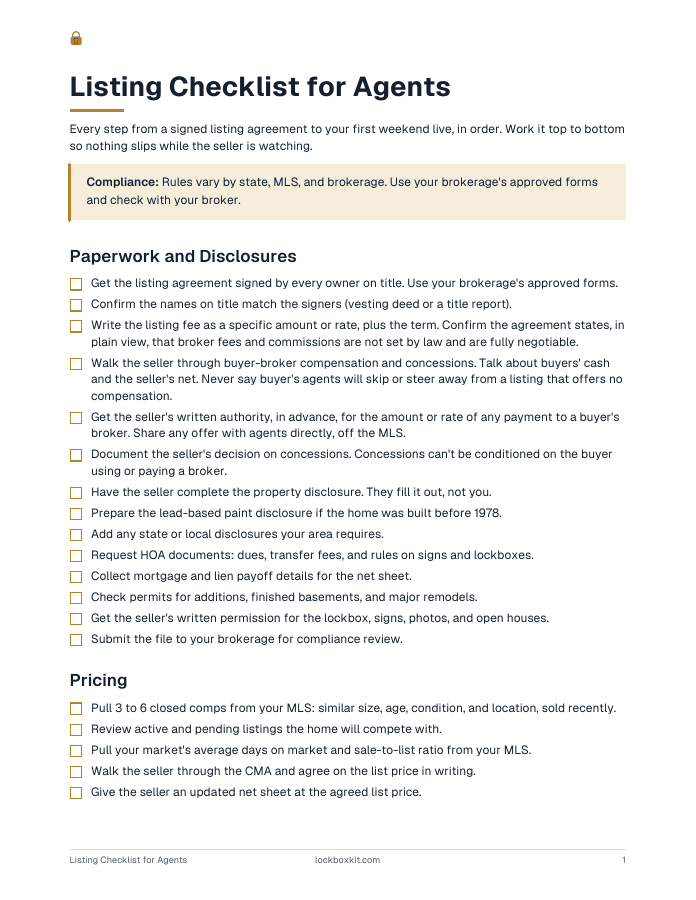
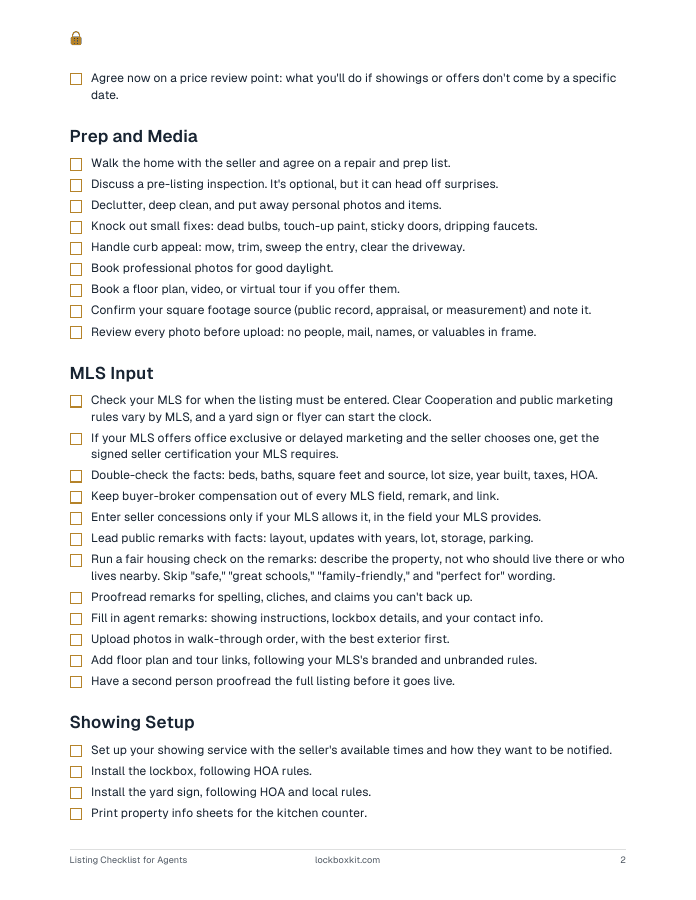
A listing checklist for agents keeps a dozen moving parts from slipping. Between the appointment, the paperwork, the prep, the launch, and the weekly updates, a listing has more steps than anyone remembers reliably. This real estate listing checklist walks through them in order, from the research you do before the appointment to the day you accept an offer. The free download is a fillable PDF with clickable checkboxes that covers the stretch from signed agreement through your first weekend live. Once you're under contract, switch to a transaction checklist.
Listing Checklist for Agents: Before the Appointment
- Pull the tax record and confirm who is on title
- Review any prior MLS history for the home
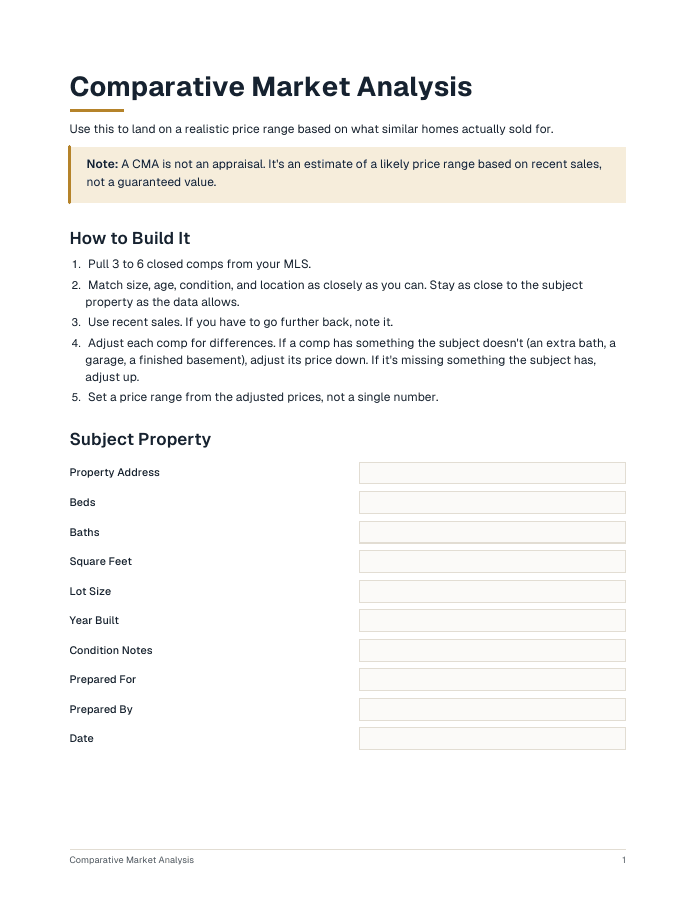
- Prepare the CMA with solds, pendings, actives, and expireds
- Prepare a seller net sheet at three price points
- Send the pre-listing packet
- Ask the seller about their timeline, next home, and the net they need
- Ask about known repairs, updates (with years), HOA, and liens
What to bring
- Your brokerage's listing agreement and the disclosures your state requires
- The form your brokerage uses for the seller's buyer-broker compensation decision
- Printed CMA and net sheet
- Your listing presentation on a tablet or laptop
- A leave-behind with your contact information
At the Listing Appointment
- Walk the home and take notes on condition and updates
- Present the market, the comps, and the pricing range
- Review the net sheet line by line
- Present your fee, what it includes, and the terms
- Explain the seller's options on buyer-broker compensation and concessions
- Get the seller's written authority, with the amount or rate, before offering anything to buyer brokers
- Sign the listing agreement with every owner who needs to sign
- Agree on the prep plan, photo date, launch date, and a price review date
- Agree on how and how often you'll update them
Compliance: Offers of compensation to buyer brokers can't appear on the MLS. A seller can still offer buyer-broker compensation off the MLS, buyers can ask for it in their offers, and seller concessions can appear on the MLS if your MLS allows it (never conditioned on paying a buyer's broker). Rules vary by state, MLS, and brokerage. Use your brokerage's approved forms and check with your broker.
What to Include in the Listing Agreement
Use your brokerage's form. Before the seller signs, confirm it covers:
- Every owner on title as a signer
- The property, list price, and start and end dates
- Your brokerage's fee, as an amount or rate
- A conspicuous statement that broker fees and commissions are not set by law and are fully negotiable
- The seller's written authority, in advance, for any payment to a buyer's broker, with the amount or rate
- The seller's marketing choice, including any office exclusive or delayed marketing option your MLS offers, with the signed seller certification it requires
- The agency or representation disclosures your state requires
- Permission for the lockbox, sign, photos, showings, and open houses
- What happens if the seller cancels, and any protection period
Paperwork and Disclosures
- Listing agreement submitted to your brokerage
- State-required seller disclosure completed by the seller
- Lead-based paint disclosure for homes built before 1978
- HOA documents, dues, and rules requested
- Any local disclosures your brokerage requires
- Mortgage and lien information gathered for the net sheet
- Brokerage file started and documents uploaded on time
Let the seller complete their own disclosures. You can explain the form, but the answers are theirs.
MLS Options and Timing
These rules moved a lot in 2025 and 2026, and many are now set locally:
- Clear Cooperation. NAR's policy still says a listing must go into the MLS within one business day of public marketing, and yard signs, flyers, websites, and email blasts count as public marketing. Enforcement varies, so check your MLS.
- Office exclusives and delayed marketing. Each needs a signed seller certification, and your MLS decides how delayed marketing works, including whether it exists at all.
- Coming Soon. Whether you can use it, and what it allows, depends on your MLS.
- State law. Some states have passed or are considering laws that require public marketing of listings.
Prep the Home
- Walk the home with the seller to list repairs and touch-ups
- Schedule repairs and confirm completion dates
- Deep clean and declutter, room by room
- Plan staging, whether full staging or rearranging what they own
- Measure rooms and note the square footage source
- Book the photographer, plus floor plan or video if you offer them
- Remove personal photos and documents from view before photos
Walk-through: what buyers will notice when they view it
- Age of the roof, furnace, air conditioning, and water heater (ask for records)
- Water stains, musty smells, or a damp basement
- Windows and doors that stick or have fogged glass
- Pet, smoke, or cooking odors
- Peeling paint, worn flooring, and burned-out bulbs
- Additions or finished spaces that may lack permits
- Gutters, grading, and drainage
The seller's list: 10 things to do before listing
- Gather mortgage statements, the tax bill, HOA details, warranties, and permits.
- Fix the small things: bulbs, drips, sticky doors, loose handles.
- Declutter and pack what they won't need before moving.
- Deep clean, including windows and carpets.
- Mow, trim, sweep, and clear the entry.
- Put away valuables, medications, and personal papers.
- Decide on a pre-listing inspection with you.
- Complete the seller disclosure honestly and completely.
- Plan where pets and household members will go during showings.
- Line up their next move and a realistic timeline.
MLS Input and Launch
- Enter every field and check it against your notes
- Confirm square footage, lot size, taxes, HOA dues, and year built
- Keep any compensation information out of every MLS field and remark
- Upload photos in a logical walk-through order
- Set showing instructions and test the lockbox
- Get the seller's approval on the listing before it goes live
- Check how the listing looks on a phone after it goes live
- Order the sign and post it per local and HOA rules
- Schedule the first open house if the seller wants one
- Send the launch announcement to your opted-in list and mail just-listed cards to neighbors
Compliance: If you call or text neighbors about the new listing, that's a telephone solicitation. Scrub every number against the National Do Not Call Registry and your state's list first. Door knocking and mail aren't covered by the Registry, but respect "No Soliciting" signs and local rules.
Fair housing check on your remarks
Describe the property, never the people you think should live there.
- Fine under HUD's 1995 guidance: "family room," "master bedroom" or "primary bedroom," "mother-in-law suite," "walk-in closets."
- Avoid: "perfect for young couples," "adults only," "singles," or anything that states a preference for or against a protected class.
- Skip subjective or coded claims: "family-friendly," "safe neighborhood," and "great schools." If buyers ask about schools or crime, give everyone the same objective, sourced data.
Federal law covers race, color, religion, sex, disability, familial status, and national origin. Many states and cities add more, such as sexual orientation and gender identity in Minnesota, California, and New York.
While the Listing Is Active
- Send a weekly update on the same day every week
- Share showing feedback, online activity, and new competing listings
- Share new sales nearby and what they mean
- Hold open houses on the agreed schedule
- Review price on the date you set at the appointment
- Update the net sheet when the price changes
Say this: Here's your update for the week of [Date]. Showings: [Number]. Feedback: [Summary]. Online views: [Number]. New competing listings: [Address or none]. Recent sales nearby: [Address and price]. This week I [what you did]. Next week I'll [what you'll do]. Call me anytime at [Phone].
Offers
- Present every offer to the seller promptly, comparing net proceeds, not just price
- Review financing, contingencies, closing date, and concessions
- Review any request for buyer-broker compensation or concessions, and never hold an offer while negotiating compensation
- Get the seller's written authority, with the amount or rate, before agreeing to pay a buyer's broker
- Update the net sheet for each offer
- Respond in writing on your brokerage's forms
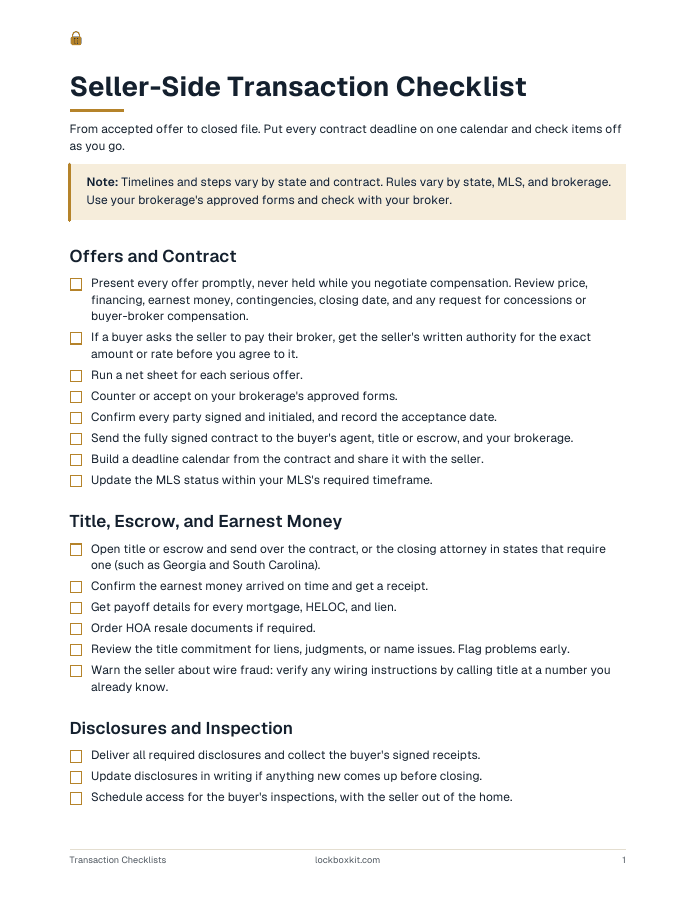
- Once accepted, send the contract to title or escrow and open the transaction checklist
Common Listing Mistakes This Checklist Prevents
- Wrong facts in the MLS. A wrong bedroom count or square footage costs you credibility and can create problems later.
- Missing signatures. Everyone on title who needs to sign, signs.
- Compensation in the wrong place. Keep it out of the MLS and get the seller's authority in writing.
- Photos before prep is finished. Shoot once, after the home is ready.
- No price review date. Agree on it at the appointment so the later conversation is about the plan, not blame.
Sources
- NAR Policy Statement 8.11: No offers of compensation in the MLS
- NAR Policy Statement 8.12: Required consumer disclosures
- NAR Multiple Listing Options for Sellers
- NAR Policy Statement 8.00: Clear Cooperation
- HUD 1995 advertising guidance (copy hosted by Metro Fair Housing Services)
- NAR FAQs on Steering, Crime and Schools (June 2026)
Questions agents ask
What should be included in a listing agreement?
Use your brokerage's approved form. It generally covers the owners and the property, the list price, start and end dates, your brokerage's fee as an amount or rate, a conspicuous statement that broker fees are not set by law and are fully negotiable, the seller's marketing choices, and any authorized payment to a buyer's broker with its amount or rate. Rules vary by state, MLS, and brokerage, so check with your broker.
Can a seller decide not to sell after listing?
Yes, but the listing agreement controls what happens next. The seller can ask to withdraw or cancel, and the brokerage, not just the agent, has to agree to a release and its terms. The agreement may call for fees or reimbursed costs, and it may include a protection period after it ends. If a purchase contract is already signed, that contract governs, so the seller should talk to an attorney.
Do agents charge if a seller decides not to sell?
It depends on the listing agreement. Some agreements charge nothing if the seller changes their mind before there's an offer. Others include a cancellation fee, reimbursement of marketing costs, or a fee if the seller sells to someone during the term or a protection period afterward. Walk the seller through these terms before they sign, so a change of plans later doesn't turn into a dispute.
Is it better to cancel a listing or let it expire?
It depends on the agreement and the seller's plans. An expiration ends the agreement on its end date. A cancellation ends it early, by agreement with the brokerage. In many MLSs, a withdrawal takes the home off the market while the agreement stays in effect. Each status shows differently in your MLS, so review the agreement's terms with the seller and check with your broker before agreeing to anything.
How long after listing until the first showing?
Showings usually start when the listing goes active in the MLS. Some MLSs have a Coming Soon status or a delayed marketing option with their own showing rules, so check yours before you promise a date. Some sellers choose a set first showing date so every buyer gets a fair look. Whatever you choose, put it in the showing instructions and confirm it with the seller in writing.
What is the hardest month to sell a house?
It depends on your market, so skip the national headlines. Pull closed sales, new listings, and median days on market by month for the last few years from your MLS. Show the seller when activity in their area tends to rise and dip, then plan the launch date and pricing around that local pattern and the seller's own timeline.