A real estate transaction checklist is what keeps a deal from depending on your memory. Every contract has a dozen dates, every party needs something from someone else, and one missed deadline can cost your client money or protections. This checklist covers the buyer side from the first meeting, the seller side from the signed listing, everything both sides share under contract, closing day, and the handoff to a transaction coordinator. The free download is a fillable PDF with clickable checkboxes for the seller side and the buyer side, from contract to close.
How to Use This Real Estate Transaction Checklist
- On the day the contract is signed, write every deadline from the contract onto the timeline below.
- Assign each task to a person: you, your coordinator, the client, the lender, or the title or escrow company.
- Add your brokerage's file submission deadlines.
- Share the dates with your client in writing.
- Review the checklist every morning until closing.
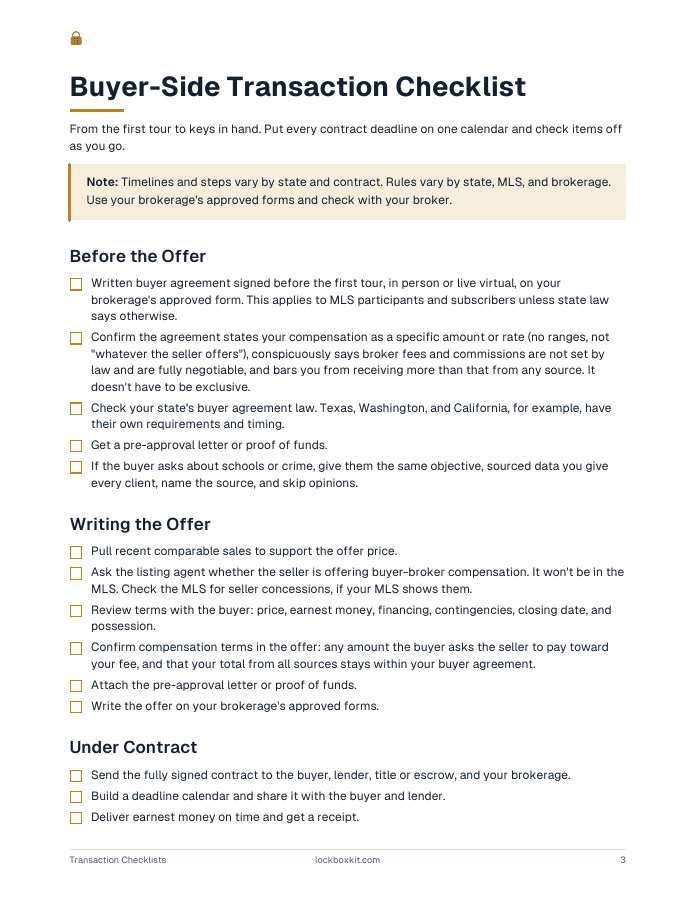
Buyer Side: Before the First Tour
- Hold a buyer consultation, in person or by video
- Explain your services and how you're paid (never call your services "free" unless you receive nothing from any source)
- Sign a written buyer agreement before touring any home, in person or by live virtual tour
- State your compensation as a specific amount or rate (no ranges, not "whatever the seller offers")
- Include the conspicuous statement that broker fees and commissions are not set by law and are fully negotiable
- Include the term that you won't accept more from any source than the agreement allows
- Explain how your fee may be paid: by the buyer, by a seller who offers it, or through a request in the buyer's offer
- Get a pre-approval letter or proof of funds
- Set search criteria based on the property: price, size, features, location
- If the buyer asks about schools or crime, share the same objective, sourced data you give every client, without opinions
Compliance: State law can add to the MLS rule. Texas requires a written agreement before showing a home (or before presenting an offer if no home is shown), effective January 1, 2026. Washington requires a services agreement when brokerage services begin, or as soon as reasonably practical after, with a 60-day default term for buyers. California requires one no later than the buyer's offer, for no more than three months. A buyer who visits an open house on their own doesn't need one. Rules vary by state, MLS, and brokerage. Use your brokerage's approved forms and check with your broker.
Buyer Side: Offer to Contract
- Run a CMA to support the offer price
- Review seller disclosures and HOA information available before writing
- Ask the listing agent whether the seller is offering buyer-broker compensation or concessions (it won't be in the MLS)
- Decide with the buyer whether to ask the seller, in the offer, to pay your fee or contribute concessions
- Confirm the earnest money amount and how it will be delivered
- Choose contingencies and timeframes with the buyer
- Write the offer on your brokerage's approved forms, with proof of funds or pre-approval attached
- Track any counteroffers in writing
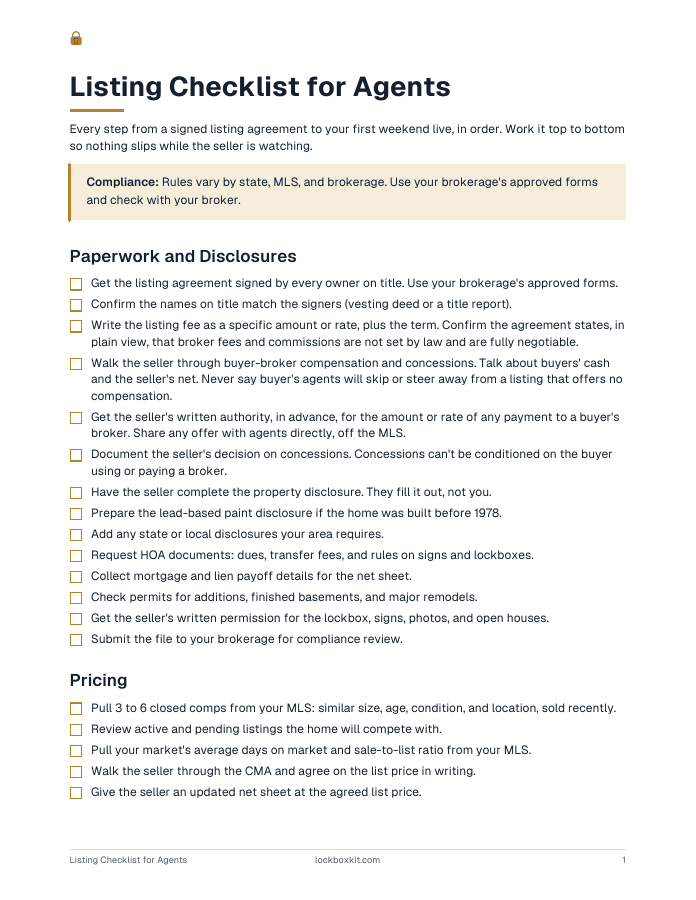
Seller Side: Listing to Contract
- Signed listing agreement with the "not set by law and fully negotiable" statement
- Seller's written authority, in advance, with the amount or rate, for any payment to a buyer's broker
- Concessions, if offered, on the MLS only if your MLS allows, and never tied to paying a buyer's broker
- No compensation offers anywhere in the MLS
- Required seller disclosures completed and available to buyers
- Lead-based paint disclosure for homes built before 1978
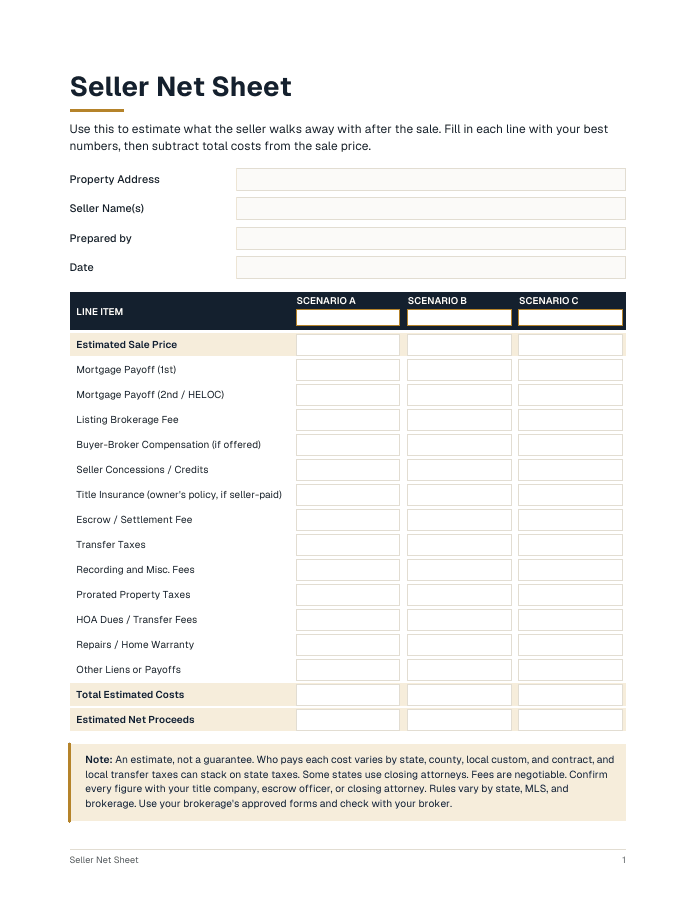
- Every offer presented promptly and reviewed with an updated seller net sheet
- Accepted contract signed by all parties and delivered to title or escrow
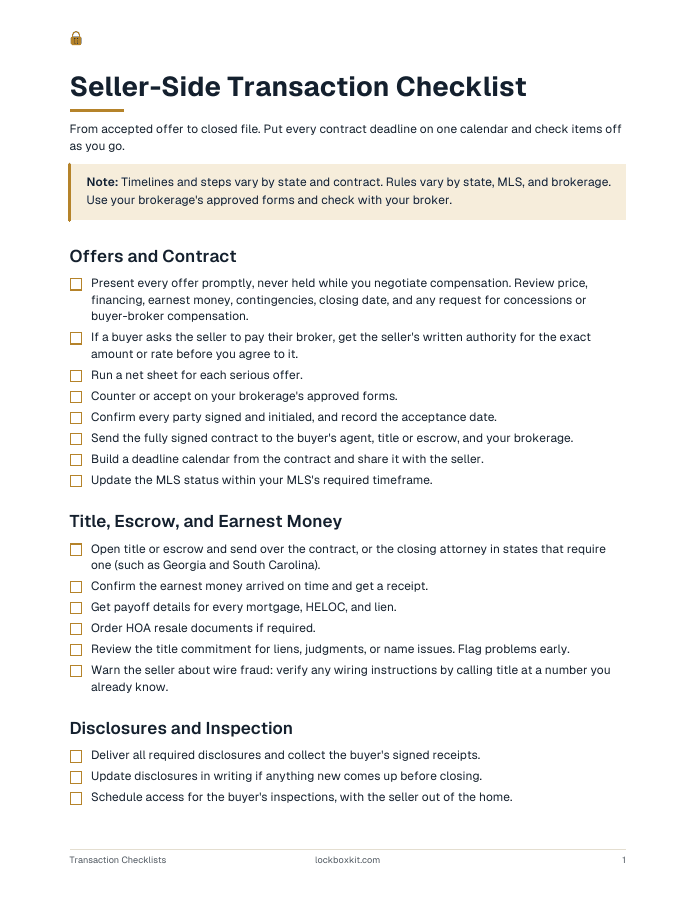
Under Contract: Both Sides
This is the heart of any transaction coordinator checklist.
| Milestone | Who | Deadline |
|---|---|---|
| Contract to title or escrow | Agent or TC | [Date] |
| Earnest money delivered | Buyer | [Date] |
| Inspection period ends | Buyer | [Date] |
| Appraisal | Lender | [Date] |
| Financing approval | Lender | [Date] |
| Title review | Buyer and agent | [Date] |
| Final walkthrough | Buyer and agent | [Date] |
| Closing | Everyone | [Date] |
Contract and earnest money
- Fully signed contract sent to title or escrow, the lender, and the other agent
- Earnest money receipt saved to the file
- File opened with your brokerage
- Contact sheet created: clients, other agent, lender, title or escrow, inspector, HOA
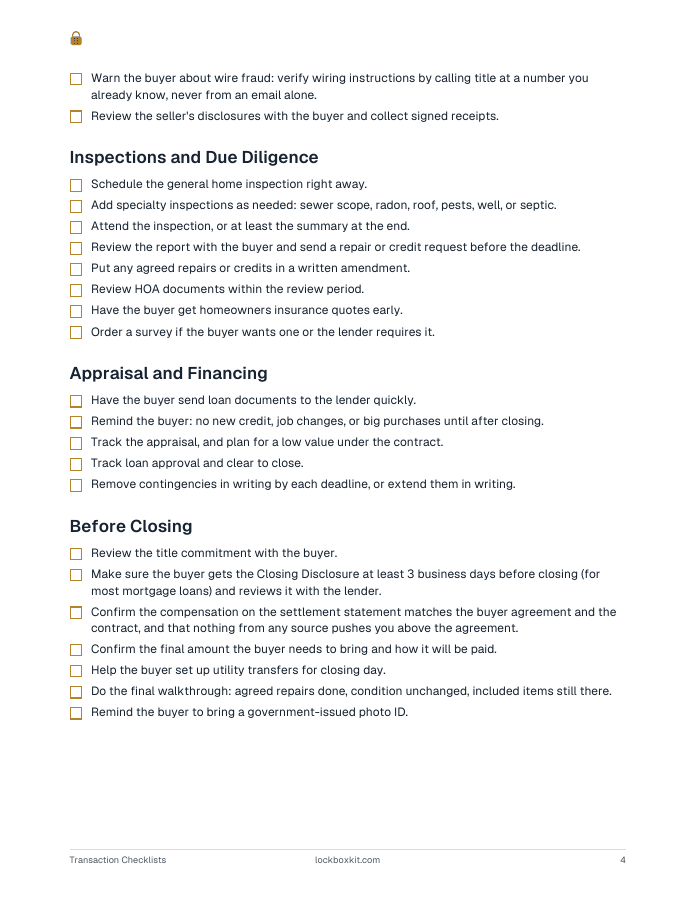
Inspections and due diligence
- General inspection scheduled and the seller told the access times
- Specialty inspections as needed: radon, sewer scope, pests, roof, well, or septic
- State-specific disclosures delivered and receipts signed
- Repair request or credit negotiated in writing before the deadline
- Contingency removals or extensions signed in writing by each deadline
- Repair receipts collected before the final walkthrough
Appraisal and financing
- Appraisal ordered and access arranged
- Any appraisal gap handled under the contract's terms
- Loan conditions tracked weekly with the lender
- Final loan approval confirmed in writing
Title, HOA, and survey
- Title commitment reviewed and any issues sent to the right party
- Mortgage payoffs ordered for the seller
- HOA documents delivered and reviewed within any contract timeframe
- Survey ordered if the contract or lender requires it
- Title or escrow asked whether any tax withholding applies, such as FIRPTA when the seller is a foreign person
Closing prep
- Wire fraud warning sent to the buyer and seller in writing
- Buyer receives the Closing Disclosure at least three business days before closing (for most mortgage loans) and reviews it with the lender
- Seller reviews the settlement statement against the net sheet
- Compensation on the settlement statement matches the buyer agreement, the listing agreement, and the contract
- Utility transfer reminders sent to both clients
- Final walkthrough done and any issues documented
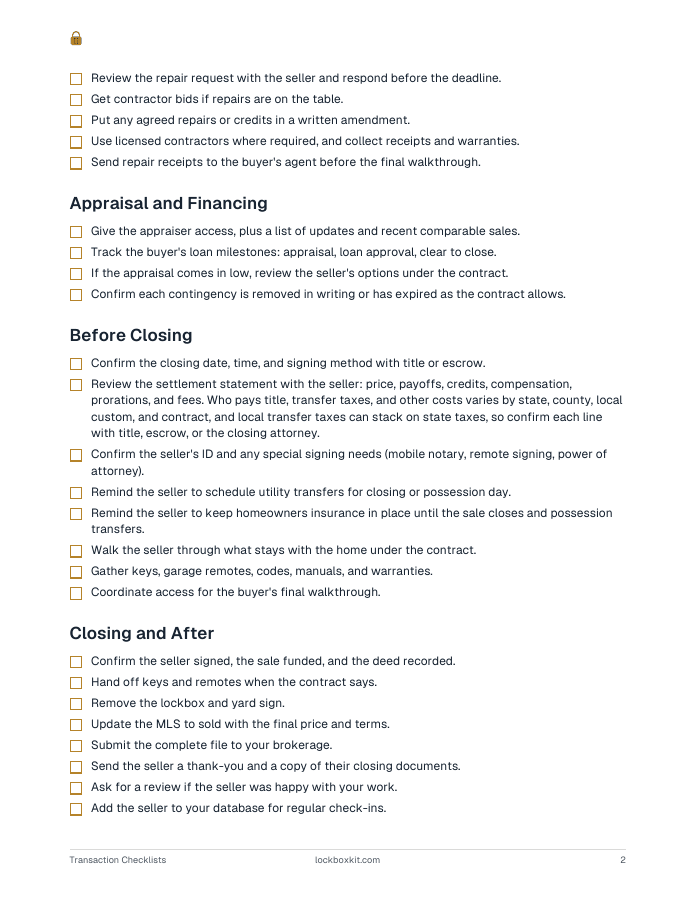
Closing Day Checklist
- Government-issued photo ID for every signer
- Buyer funds sent as title or escrow instructs, with wiring instructions verified by phone at a known number
- Any power of attorney approved by title or the closing attorney in advance
- Seller brings keys, garage remotes, codes, manuals, and warranties
- Both clients read their final figures before signing
What not to do during closing: no new credit, big purchases, or job changes for the buyer; no wires based on emailed instructions; and no canceling the seller's homeowners insurance until the sale closes and possession transfers.
After Closing
- Buyer: change or rekey the locks, reset garage and alarm codes, keep the closing documents, and file any homestead exemption your state offers
- Seller: cancel homeowners insurance after possession transfers, forward mail, and keep the settlement statement for taxes
- You: remove the lockbox and sign, update the MLS, submit the file to your brokerage on time, and confirm commission disbursement
- Everyone: a thank-you and a follow-up date in your calendar
Transaction Coordinator Checklist: Duties and the Handoff
A coordinator's core duties are opening the file, building the deadline calendar, collecting signatures, chasing the lender and title, and submitting a complete file to the brokerage. A good coordinator works from one shared checklist, picks up the phone when an email thread stalls, and flags a deadline days before it arrives, not the morning of.
If a coordinator takes the file, hand over:
- The fully signed contract and all addenda
- The contact sheet for every party
- The deadline timeline
- Notes on anything unusual: repairs, credits, tenants, or a sale contingency
- Which tasks the coordinator owns and which stay with you, in writing
Compliance: What an unlicensed coordinator may do varies by state. Keep negotiation and client advice with a licensed agent unless your state and brokerage say otherwise.
Where Deals Usually Slip
- A deadline nobody owned. Every date on the timeline needs a name next to it.
- Verbal agreements. A repair agreed on the phone isn't agreed until it's in writing and signed.
- Late HOA documents. Request them the day the contract is signed.
- Quiet lenders. Check in on loan conditions weekly, even when no one has asked for anything.
- Surprises on the settlement statement. Compare it with the net sheet early, so the seller hears about differences from you first.
Sources
Questions agents ask
What are the duties of a transaction coordinator?
A transaction coordinator manages paperwork and deadlines from contract to close: opening the file, building the deadline calendar, collecting signatures, keeping the lender, title or escrow, and the other agent on track, and submitting the file to the brokerage. What a coordinator may do depends on whether they're licensed, your state's rules, and your brokerage's policy, so put the split of duties in writing.
Do you need a real estate license to be a transaction coordinator?
It depends on your state and the tasks. Unlicensed coordinators commonly handle scheduling, document collection, and file management, but state license laws limit what unlicensed people can do, such as negotiating or advising clients. Check your state real estate commission's rules and your brokerage's policy before you hand off anything that touches the client relationship or the terms of the deal.
How much should you pay a transaction coordinator?
There's no fixed price. Coordinators may charge a flat fee per file, often due at closing, or work hourly or on salary inside a brokerage or team. Get quotes from a few local coordinators and compare exactly what each fee covers. Then confirm your brokerage's policy and your state's rules on how you may pay them, especially if they're unlicensed.
What documents are needed at a real estate closing?
Everyone signing needs a valid government-issued photo ID. Buyers bring funds the way the title or escrow company instructs, after confirming wiring instructions by phone, plus anything the lender requests. Sellers bring keys, remotes, and codes, and any payoff, HOA, or repair paperwork still outstanding. If anyone signs under a power of attorney, get it approved by the title company or closing attorney in advance.
What should buyers and sellers not do during closing?
Buyers shouldn't open new credit, make big purchases, change jobs, or move large sums without checking with their lender first. Nobody should wire money using instructions from an email without calling the title company at a known number. Sellers shouldn't cancel homeowners insurance until the sale closes and possession transfers. And no one should sign before reading the Closing Disclosure or settlement statement.
Who owns the house on closing day?
Ownership changes when the sale closes under your state's process: the deed is signed and delivered, and in many places the sale funds and the deed records. Possession is a separate question the purchase contract answers. For property taxes, IRS Publication 530 treats the seller as paying up to, but not including, the date of sale, so closing day counts as the buyer's.