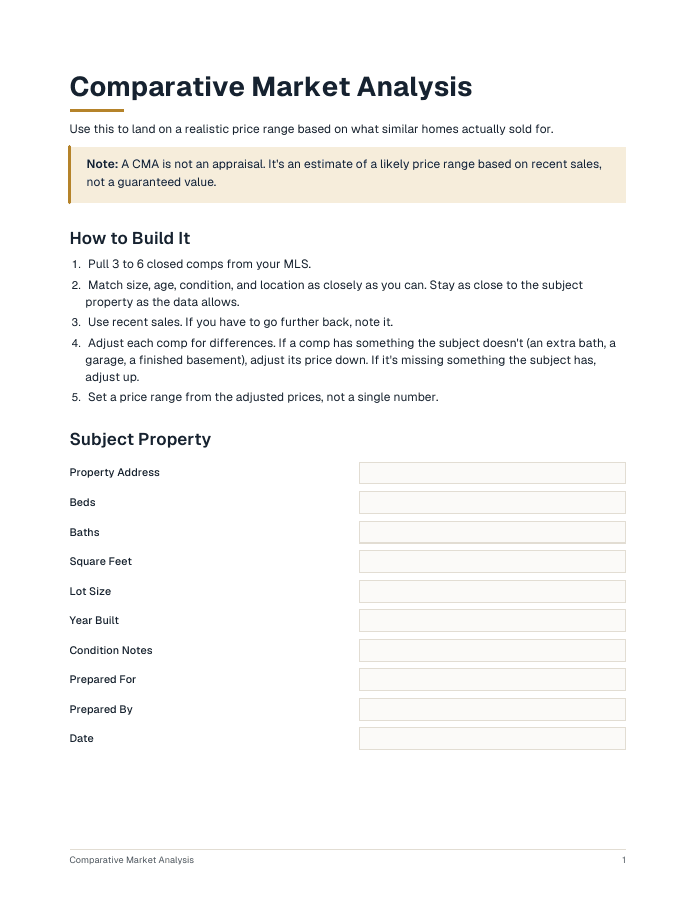
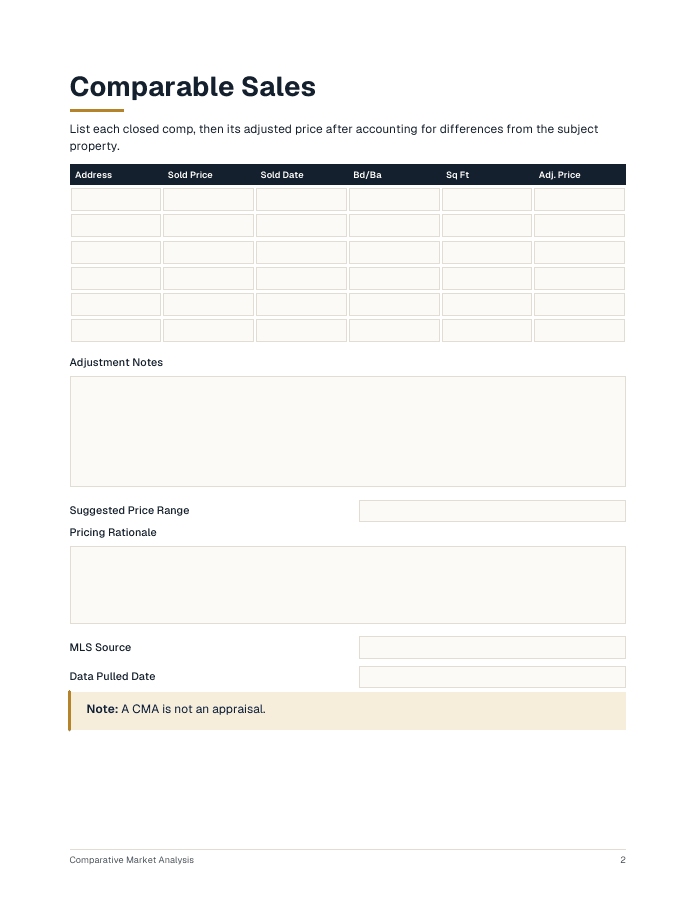
A CMA template keeps your pricing work consistent: same steps, same adjustment grid, same layout every time you sit down with a seller. Below is how to do a CMA in eight steps, how to calculate adjustments, the grid to use, and how to present the result so the seller follows your reasoning. The free CMA template is a fillable PDF with a subject property page, a comp grid that carries each sale through to an adjusted price, space for adjustment notes, and a suggested price range with your rationale.
What Is a Comparative Market Analysis?
A comparative market analysis is your opinion of what a home is likely to sell for, based on what similar homes sold for, what's pending, and what buyers can choose from right now. You use it to recommend a list price, to help a buyer decide what to offer, and to reset the price on a listing that isn't moving.
It is not an appraisal. Put this line at the bottom of every report: "This is an opinion of price prepared by a real estate agent. It is not an appraisal."
What Goes in a CMA Template
A complete CMA has seven parts:
- Subject property summary. Beds, baths, square footage with its source, lot, year built, condition, and updates.
- Sold comparables. Three to six of the closest recent sales.
- Pending sales. What's under contract now and at what list price.
- Active listings. The homes the seller will compete against.
- Expired and withdrawn listings. What didn't sell, and at what price.
- Adjustment grid. How each sold comp compares to the subject, and its adjusted price.
- Price range and recommendation. A range, a recommended list price, and why.
How to Do a CMA in 8 Steps
1. Get the subject property facts right
Pull the tax record and any prior MLS listing. Then walk the home and note condition, updates (with years), layout quirks, and anything an inspector will flag. Many bad CMAs start with wrong square footage or a missed basement.
2. Set your search
Start narrow: same neighborhood or subdivision, similar style, similar finished square footage, similar age, and the most recent sales. Widen one filter at a time only if you don't have enough comps.
3. Pull four lists
Sold, pending, active, and expired or withdrawn. Solds show what buyers paid. Pendings show where the market is heading. Actives show the competition. Expireds show where buyers said no.
4. Pick your best comps
Read every listing, including photos and remarks. Throw out sales that weren't normal market sales, like transfers between family members, or homes in very different condition, unless you can adjust for them honestly. Keep three to six.
5. Adjust each comp toward the subject
Here's the math for each comp:
Adjusted price = comp's sale price, plus the value of features the subject has that the comp lacks, minus the value of features the comp has that the subject lacks.
Example: Comp 1 sold for [Sale Price]. It has a third garage stall the subject doesn't, so subtract [Garage Value]. The subject has a finished basement the comp doesn't, so add [Basement Value]. Comp 1's adjusted price is [Sale Price] minus [Garage Value] plus [Basement Value].
Base each value on paired sales in your own MLS, not national rules of thumb.
6. Reconcile into a range
Look at the adjusted prices. Give the most weight to the comps that needed the fewest adjustments. Your range is where those strongest comps land.
7. Check the range against the competition
Line up your range with current actives. If a buyer could get a similar or better home for less right now, your list price has to account for that.
8. Write the recommendation
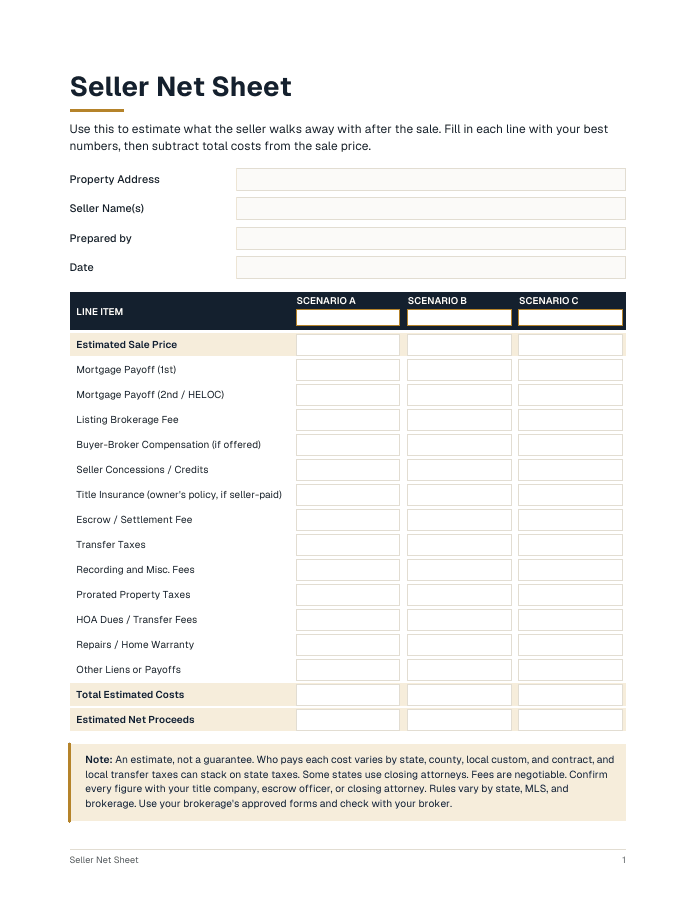
State the range, your recommended list price, and two or three sentences explaining why. Then build a seller net sheet at the low, middle, and high end so the conversation turns to what they'll actually walk away with.
Comparative Market Analysis Template: The Adjustment Grid
Build one grid per sold comp:
| Feature | Subject | Comp 1 | Adjustment |
|---|---|---|---|
| Sale price | n/a | [Sale Price] | n/a |
| Sale date | n/a | [Date] | [+/- $] |
| Finished sq ft | [Sq Ft] | [Sq Ft] | [+/- $] |
| Beds / baths | [Beds/Baths] | [Beds/Baths] | [+/- $] |
| Garage | [Spaces] | [Spaces] | [+/- $] |
| Condition / updates | [Notes] | [Notes] | [+/- $] |
| Lot | [Lot Size] | [Lot Size] | [+/- $] |
| Adjusted price | [Adjusted Price] |
Tip: Ask a local appraiser how they handle common adjustments like garages, finished basements, and lot size in your area. One short call will sharpen every CMA you do after it.
Adjusting for Time and Season
Prices can move between a comp's sale date and today. If your market has shifted since a comp closed, adjust for it and note how you got the number, for example from the change in median sale price for similar homes in your MLS over that stretch.
Sellers also ask, "What's the hardest month to sell a house?" The honest answer is that it depends on your market. Pull closed sales, new listings, and median days on market by month for the last few years from your MLS, and show the seller the pattern for their area. Use that, not a national headline.
Price Per Square Foot: Useful Check, Bad Shortcut
Price per square foot is a quick way to spot a comp that looks off. It's a bad way to set a price. Smaller homes often show a higher price per square foot than larger homes nearby, and the number ignores condition, lot, and layout. Use it to double-check your adjusted range, never to replace it.
CMA Tools: MLS Report, Excel, Word, or PDF?
There's no single best CMA calculator. Pick the tool by the job:
| Tool | Good for | Watch for |
|---|---|---|
| MLS CMA report | Pulling comps and photos fast | Automatic adjustments you didn't check |
| Excel or Google Sheets | Adjustment math | A layout sellers can't follow |
| Word or Google Docs | Narrative and rationale | Retyping numbers by hand |
| Fillable PDF template | The same clean layout every time | Data still comes from your MLS |
Whatever you use, every number should trace back to your MLS or public records, and every adjustment should have a reason you can say out loud.
How to Present the CMA to a Seller
- Start with the actives. Ask which one they'd buy.
- Walk through each sold comp and its adjustments. Invite questions.
- Show the expireds and talk about what those sellers learned.
- Show the range, then your recommendation.
- Move to the net sheet.
Before I show you a number, which of these active homes would you buy if you were shopping today?
Probably the one on [Street Name]. It's bigger.
That's what buyers will think too. Now let's look at what homes like yours have actually sold for.
Let the seller reach the range with you. Don't lead with the number.
Schools, Crime, and Neighborhood Data
Sellers sometimes ask how schools or crime affect their price, and some CMA tools add neighborhood pages. In April 2026, HUD said agents don't violate the Fair Housing Act just by sharing school and crime data with clients in an equal and consistent way. NAR's June 2026 FAQ agrees, and adds that opinions still create steering risk and that HUD's letter doesn't bind courts or private plaintiffs.
- Use objective data from reliable sources, like the school district or police department, and name the source.
- Give every client the same information.
- Skip opinions like "good schools" or "safe area."
- Never volunteer the racial, religious, or ethnic makeup of a neighborhood.
CMA vs. Appraisal: What Agents Can and Can't Do
| Point | CMA | Appraisal |
|---|---|---|
| Prepared by | Real estate agent | Licensed or certified appraiser |
| Used for | List price or offer price | Lending and other formal valuations |
| Cost | Usually no charge for a listing or offer | A fee, often paid by the borrower |
Agents prepare CMAs all the time. Just don't call yours an appraisal. If you're a NAR member, Article 11 of the Code of Ethics expects you to know the property type and the area before giving a price opinion, or to disclose that you don't, and it spells out what a price opinion prepared for other purposes must include. If someone wants a paid opinion of value for an estate, a divorce, or a loan, check your state's rules on broker price opinions and your brokerage's policy first.
Compliance: A CMA is an opinion of price, not an appraisal. Rules vary by state, MLS, and brokerage. Use your brokerage's approved forms and check with your broker.
Common CMA Mistakes
- Using the seller's favorite sale. Include the high sale down the street if it's a true comp, and explain the adjustments if it isn't.
- Ignoring condition. Two homes with the same square footage can be very different sales if one was updated last year.
- Crossing obvious boundaries. A busy road, a different subdivision, or a different taxing district can change prices. Stay on the subject's side when you can, and note it when you can't.
- Leaving out expireds. They show the seller where the market already said no.
CMA Checklist Before the Appointment
- Subject facts verified in person
- Square footage source noted
- Three to six sold comps, each read in full
- Unusual sales removed or explained
- Adjustments based on local paired sales
- Pendings, actives, and expireds included
- Range and recommendation written out
- Net sheet prepared at three price points
- "Not an appraisal" line on the report
Sources
Questions agents ask
What is a comparative market analysis?
A comparative market analysis (CMA) is an agent's opinion of a home's likely sale price, based on recent sales, pending sales, and active listings of similar homes nearby. Agents use it to recommend a list price to sellers or an offer price to buyers. It is not an appraisal, so label it as an opinion of price prepared with data from your MLS.
How do you calculate a CMA?
Pick three to six recent sales that are as close to the subject home as you can find. For each one, start with the sale price, subtract the value of features the comp has that the subject lacks, and add the value of features the subject has that the comp lacks. Base those values on local paired sales. Give the most weight to the comps that needed the fewest adjustments.
Do real estate agents charge for a CMA?
Agents usually prepare a CMA at no charge when they're competing for a listing or helping a buyer decide what to offer. A paid opinion of value for another purpose, like an estate, a divorce, or a loan, is a different job. Some states regulate broker price opinions and when a licensee can charge for one, and some situations require a licensed appraiser. Check your state rules and brokerage policy.
Can a real estate agent do a CMA?
Yes. Preparing CMAs is a normal part of a licensed agent's work on listings and buyer offers. What an agent can't do is present it as an appraisal, so label it as an opinion of price. NAR members also follow Article 11 of the Code of Ethics, which expects you to know the property type and the area before giving a price opinion, or to disclose that you don't.
How long does it take to prepare a CMA?
It depends on the home and how well you know the area. A home in a neighborhood you work every week goes faster than a rural, custom, or unusual property with few true comps. Budget time to walk the home, read every comp listing in full, and write out your adjustments. Don't rush comp selection, because every number after it depends on it.
How do I get a comparative market analysis for my home?
Ask a local real estate agent. Many will prepare one at no cost if you're thinking about selling, and a good one will walk you through each comp and adjustment instead of just handing you a number. Online estimates are a starting point, but they can't see your home's condition or updates. Ask the agent to explain any sale they left out.