An open house sign-in sheet has one job: give you enough information to follow up with the right people and nothing you shouldn't have. This page covers what to put on the sheet, what each template looks like, paper versus QR sign-in, how to get honest answers, and what to do with the sheet before you go to bed.
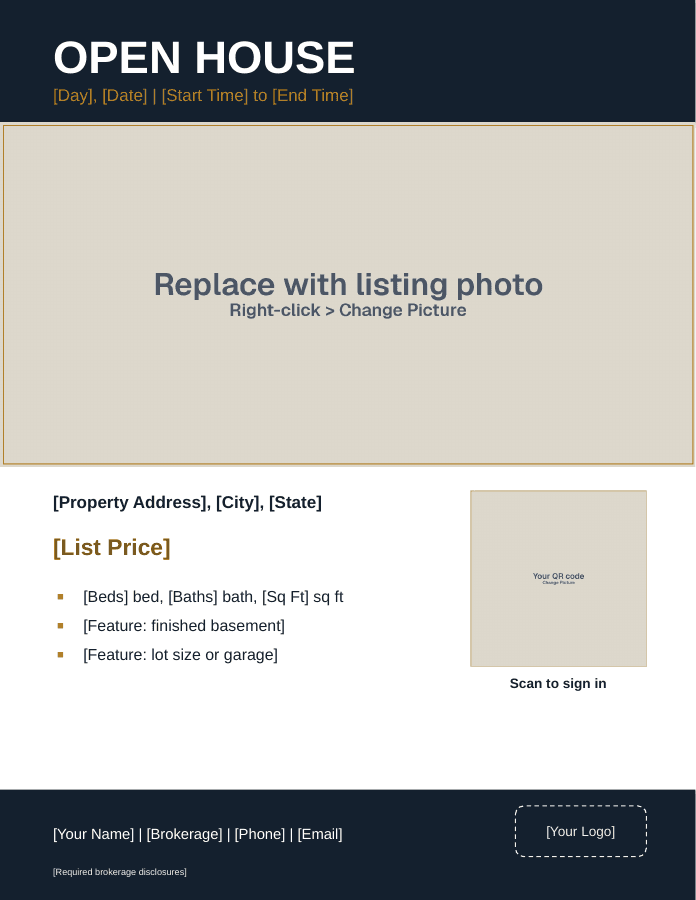
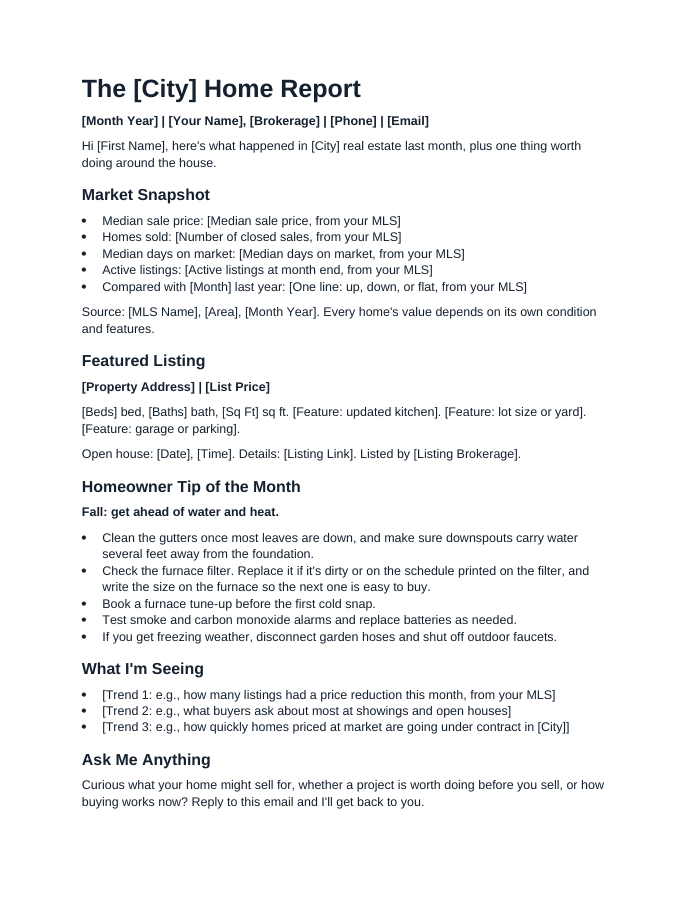
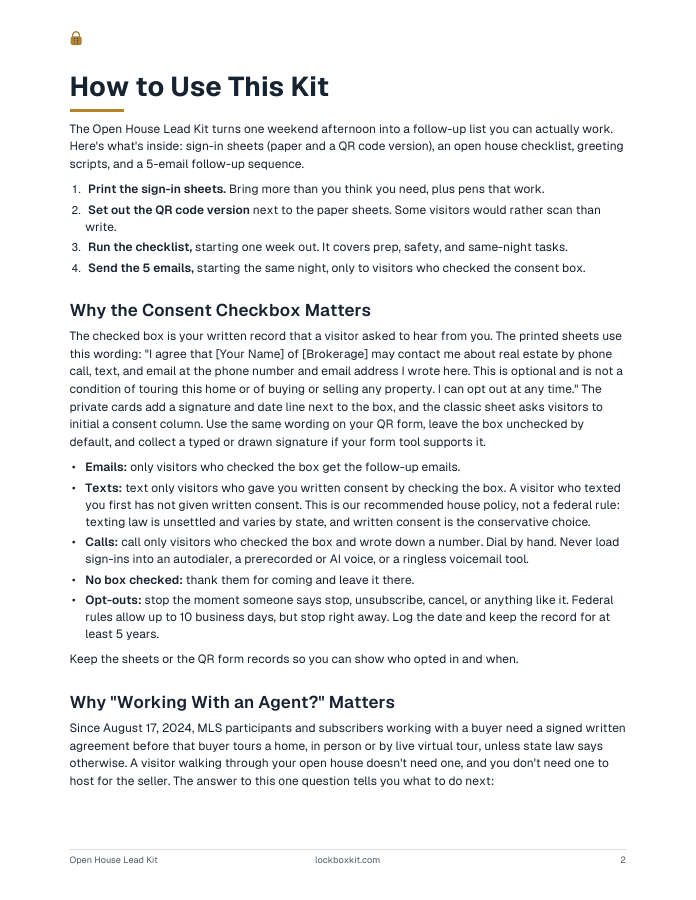
The free Open House Lead Kit is one fillable PDF and one PPTX. The PDF holds a classic sign-in sheet, private one-party cards, a QR sign-in stand sign with a box for your own QR code, an open house checklist, greeting scripts, and follow-up emails. The PPTX has an editable QR sign-in sign and an editable open house flyer. The kit does not create a QR code or an online form; you make those with your own tools.
What to Put on an Open House Sign-In Sheet
Keep it short. Every extra field means fewer people fill it out, and every vague field gets a vague answer.
| Field | Why you need it |
|---|---|
| Name | So your follow-up is personal |
| Your main follow-up channel | |
| Phone | For a call if they ask for one |
| Working with an agent? | Tells you who to respect and who to help |
| Timeframe | Sorts this month from someday |
| Consent checkbox | Their OK to hear from you |
At the top of the page, fill in the property address, date, and your name before you print.
For timeframe, give checkboxes instead of a blank line: 0 to 3 months, 3 to 6 months, 6 to 12 months, just looking. Checkboxes get answered. Blank lines get skipped.
For "working with an agent," add a short line for the agent's name. If a visitor already has an agent, your job is to send that agent anything their client asks for, not to win them over.
The consent line
Put the consent checkbox on its own line, unchecked, below the contact fields. Sample wording to run past your broker:
Print this next to an unchecked box: I agree that [Your Name] of [Brokerage] may contact me about real estate by phone call, text, and email at the phone number and email address I wrote here. This is optional and is not a condition of touring this home or of buying or selling any property. I can opt out at any time. Signature: ________ Date: ________
Add a signature and date line next to the box. If a visitor's number is on the National Do Not Call Registry, permission to call it has to be a signed, written agreement that includes the number (47 CFR 64.1200(c)(2)(ii)), so a checked box alone may not be enough. Marketing calls or texts to cell phones made with an autodialer or a prerecorded or AI voice need a signed, written agreement with specific disclosures. Have your broker review your wording.
What to leave off
Do not ask about household size, kids, age, marital status, where someone is from, religion, disability, or anything else about who they are. You don't need it. Federal rules bar asking whether a buyer has a disability, and some states, such as Minnesota and New York, also bar records or inquiries that express a limitation based on a protected class. If a visitor volunteers personal details, don't write them down.
Optional: one property feedback line
Sellers want to know what visitors thought. If you want feedback in writing, add one optional line: "What did you think of the home and the price?" Ask it of everyone, keep it about the property, and share the answers with your seller without names.
What Does an Open House Sign-In Sheet Look Like?
Here is each version in the kit, described so you can also build your own.
Template 1: The classic sheet
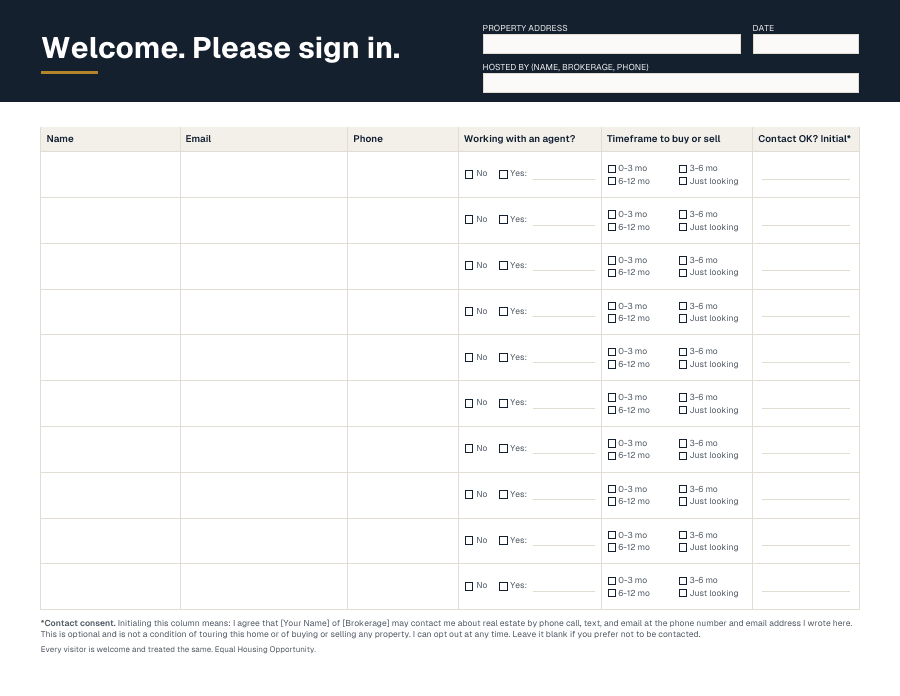
A landscape page with a header for the property, date, and host. Columns: name, email, phone, working with an agent (yes or no, plus the agent's name), timeframe checkboxes, and a contact consent checkbox, with the consent wording printed at the bottom. If you build your own on letter paper, eight to ten rows leaves enough room to write.
The downside: every visitor can read the lines above theirs, so some leave off their phone number. It works best on slow weekday opens.
Template 2: Private one-party cards
Two cards per page with a cut line. Same fields, plus "Also thinking about selling?" Each visitor group fills out its own card and drops it in a closed box or folder. Because nobody else sees their answers, visitors are more likely to write a real email. Print these for busy weekend opens.
Template 3: The QR sign-in stand sign
A sign for a stand by the door, with a box for your own QR code. Build the form in your CRM or a form builder, make a QR code that opens it, and place it in the box. Use the same fields and consent wording as the paper version, and keep cards nearby for people who would rather not scan.
Word, Canva, and Google versions
The sign-in sheets come as a fillable PDF: type the header details, then print. The QR sign-in sign and the flyer in the PPTX are editable in PowerPoint, Google Slides, Keynote, or Canva. If your brokerage wants a Word or Google Docs version of the sheet, copy the field list above into a table and add the consent line word for word.
Paper vs QR Digital Sign-In
| Paper | QR code | |
|---|---|---|
| Speed at the door | Fast | Depends on signal |
| Privacy between visitors | Low (sheet), high (cards) | High |
| Handwriting problems | Common | None |
| Data entry that night | Yes | None |
Test the QR code on a phone inside the house before visitors arrive. Basements and rural listings can have weak signal. If the form doesn't load in a few seconds, put out paper.
Picking a sign-in app? Look for one that feeds the CRM you already use, lets you edit the consent wording, and sends an automatic thank-you email. Keep paper as a backup.
How to Greet Visitors and Get the Sheet Filled Out
Honest answers come from a low-pressure ask that explains what the visitor gets in return. Greet everyone the same way, with the same words, every time.
Hi, welcome in. I'm [Your Name] with [Brokerage]. I'm hosting today for the sellers.
Thanks. Mind if we just look around?
Go right ahead. Would you sign in here first? It's how I send the disclosures, the price history, and a heads-up if the price changes.
Do I have to put my phone number?
Nope. Email is fine. The contact box at the bottom is optional too.
Hand them the pen or point to the QR sign and step back. Don't hover while they write.
Take your time. I'll be in the kitchen if you have questions.
Ask before the tour, not after; people are less likely to stop on their way out. Keep the property sheet next to the sign-in so the trade feels fair: they give you an email, you give them the details.
If a visitor won't sign in, let them tour anyway unless your seller has made sign-in a condition of entry. Pushing usually gets you a fake email.
Tip: If a visitor says they are working with an agent, thank them and ask for the agent's name. Then treat that visitor like any other guest.
Fair housing at the door
Every visitor gets the same greeting, the same sign-in request, the same property sheet, and the same follow-up. Don't guess who is a "serious buyer" from how someone looks or sounds. Keep your answers about the home, and never describe who lives in the area. If someone asks about schools or crime, you can share objective, sourced data, such as the school district's own reports or police department statistics, as long as you give every visitor the same information and leave out opinions like "good" or "safe."
What to Do With the Sheet That Night
The sheet loses value every hour it sits in your car. Before you go to bed:
- Photograph or scan every page and card
- Enter each visitor into your CRM, tagged "Open House, [Property Address], [Date]"
- Mark each person's consent status (call, text, email, or none)
- Mark visitors who have an agent and note the agent's name
- Sort the rest by timeframe: 0 to 3 months first
- Send the seller a short recap: number of groups and the property feedback you heard
- Check your brokerage policy before sharing any visitor's contact details with the seller
- File or shred the paper according to your brokerage's records policy
Follow-Up Timing
| When | Who | What |
|---|---|---|
| Same night | Everyone with an email | Thank-you email and property details |
| Within 2 days | Opted in, 0 to 6 months | A phone call |
| Day 7 | Opted in, no reply | One short check-in |
| Monthly | Everyone who opted in | Your email newsletter |
Calls and texts after the open house
- Texts. Our recommended house policy: text only visitors who checked the consent box. That's our policy, not federal law. A visitor who texts you a question has started a conversation, but that isn't written consent to market to them.
- Calls. Do Not Call rules cover calls and texts. A number on the National Do Not Call Registry generally needs signed, written permission that includes that number, unless another exemption applies. Unless your broker confirms your sign-in form or an exemption covers it, scrub every number against the National Registry, your state list, and your internal list before you call.
- Hours. Federal rules allow 8 a.m. to 9 p.m. in the visitor's time zone, but some states are stricter. A safe habit is 9 a.m. to 8 p.m., Monday to Saturday, no holidays.
- Opt-outs. If anyone asks you to stop, log it with the date and stop right away. Federal rules give you no more than 10 business days, but there is no reason to wait.
Compliance: Rules vary by state, MLS, and brokerage. Use your brokerage's approved forms and check with your broker. This is not legal advice.
If a visitor wants to see other homes with you, that's a buyer conversation. MLS agents working with a buyer need a signed written buyer agreement before the first tour, in person or live virtual, unless state law says otherwise. A visitor touring your open house on their own doesn't need to sign one.
Open House Sign-In Mistakes to Avoid
- A shared sheet at a busy open. Use private cards or QR sign-in so visitors can't read each other's details.
- Too many fields. Name, email, phone, agent, timeframe, and consent are enough.
- A pre-checked consent box. It has to be the visitor's choice.
- Personal questions. They create fair housing risk and add nothing to your follow-up.
- Waiting until Monday. The visitor who toured three homes Sunday remembers the agent who wrote first.
When to Use It
- Every public open house you host, including broker opens the public can attend
- Model homes and new-construction events where you are the host
- Community events where you have a table and want a clean way to collect opt-ins
Print the sheet the night before, test the QR form, and write the thank-you email ahead of time. Then the only thing left afterward is hitting send.
Sources
- 24 CFR 100.75, discriminatory notices and statements (Cornell LII)
- 24 CFR 100.202, inquiries about disability (eCFR)
- Minnesota Statutes 363A.09
- 47 CFR 64.1200, FCC telemarketing and consent rules (eCFR)
- NAR, Consumer Guide to Open Houses and Written Agreements
- NAR, FAQs on Steering, Crime and Schools (June 2026)
Questions agents ask
What does an open house sign-in sheet look like?
Most are a single landscape page with the property address, date, and host's name at the top and one row per visitor. The columns cover name, email, phone, whether the visitor is working with an agent, and a buying timeframe, plus a checkbox for permission to follow up. Private versions put the same fields on a card for each visitor, so nobody can read anyone else's details.
What is the best sign-in app for open houses?
The best one sends visitors straight into the CRM you already use, so nothing gets retyped. Many CRMs include an open house form, and any online form builder works if you link it to a QR code. Look for a consent checkbox you can edit, an automatic thank-you email, and a way to export your list. Keep paper cards nearby for visitors who would rather not scan.
What is a good turnout for an open house?
There is no single number. Turnout depends on price point, season, location, weather, and how many similar homes are open that weekend. Compare each open house with your own past ones at similar prices in the same area, which is easy when every visitor signs in. For your seller, the feedback you collect and the follow-ups you book matter more than the head count.
What are the common mistakes to avoid at open houses?
On sign-in, the big ones are a shared sheet that lets visitors read each other's details, too many fields, no consent checkbox, personal questions that create fair housing risk, and leaving the sheet in your car for days. During the event, avoid hovering, sizing up visitors by appearance, and leaving without walking every room to make sure the house is empty.
What is the etiquette for open houses?
As the host, greet every visitor the same way, ask everyone to sign in, give people room to look, and keep your answers about the property. Visitors are expected to sign in, follow the seller's rules on shoes and closed rooms, and say whether they already have an agent. When you explain what the sign-in gets them, most people are happy to fill it out.