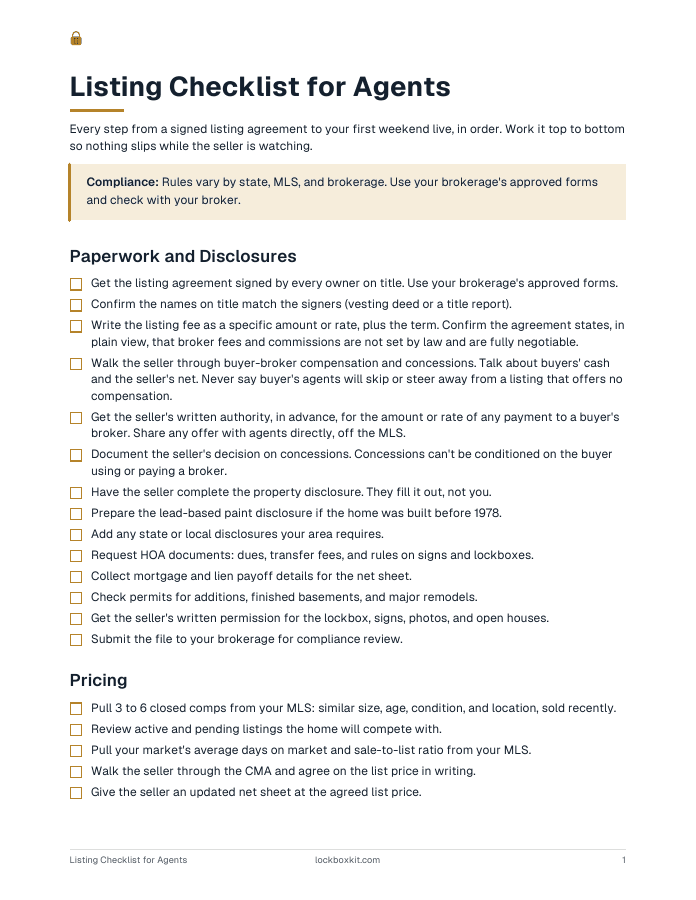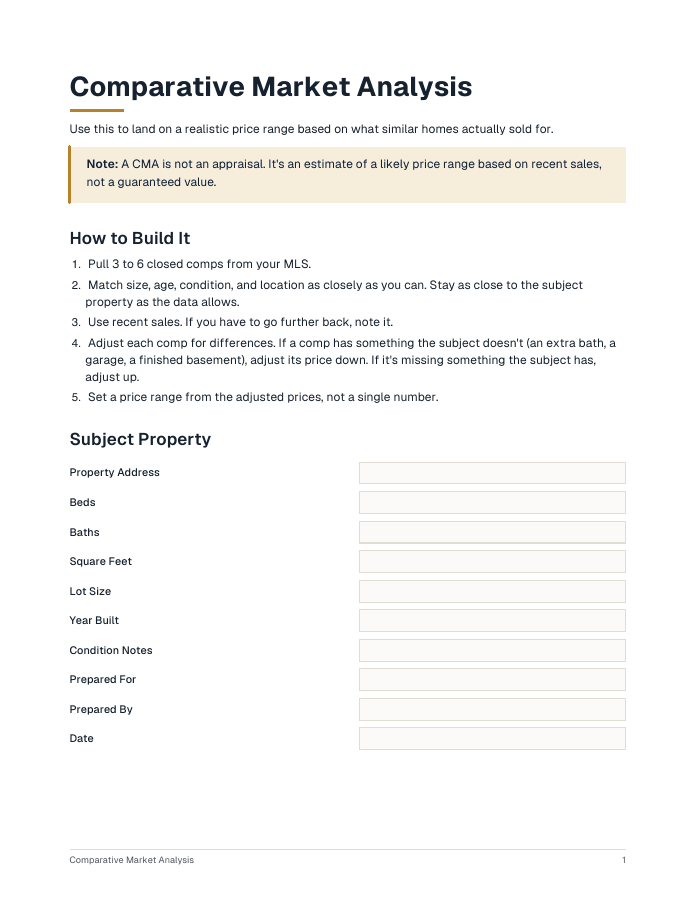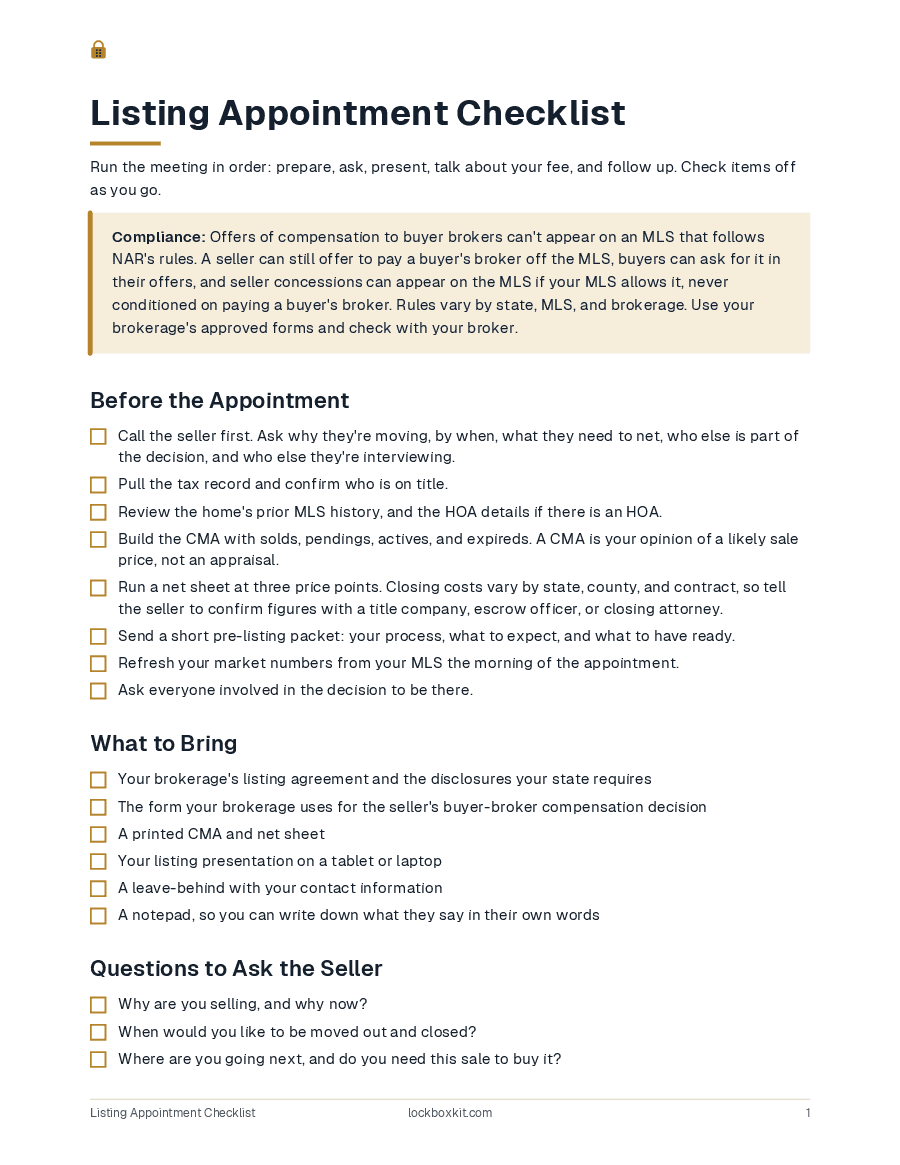
This page is about the meeting itself. For the slides, see the listing presentation template. For what happens after the seller signs, see the listing checklist.
Before You Walk In
The appointment starts with a phone call. Let the seller do most of the talking.
Hi [First Name], this is [Your Name] with [Brokerage]. Before we meet, I'd like to ask a few questions so I use your time well. Is now a good time?
Sure.
What's got you thinking about selling, and when would you like to be moved?
We want to be out by [Month], and we're buying a bigger place.
Got it. Does buying that place depend on this sale? And who else will be part of the decision?
Write their answers down in their words. Read them back at the start of the meeting.
Then do the prep: pull the tax record and prior MLS history, build the CMA, run a net sheet at three price points, and send a short pre-listing packet. Closing costs vary by state, county, and contract, so tell the seller to confirm the figures with a title company, escrow officer, or closing attorney. The CMA template and seller net sheet pages walk through those two documents, and the listing presentation page has the full prep list.
Questions to Ask the Seller
Write the answers down in the seller's own words, and read them back when you sit down.
Their situation
- Why are you selling, and why now?
- When would you like to be moved out and closed?
- Where are you going next, and does that depend on this sale?
The home
- What have you updated, and when?
- What do you know still needs work?
- Is there anything a buyer might be surprised by?
The money
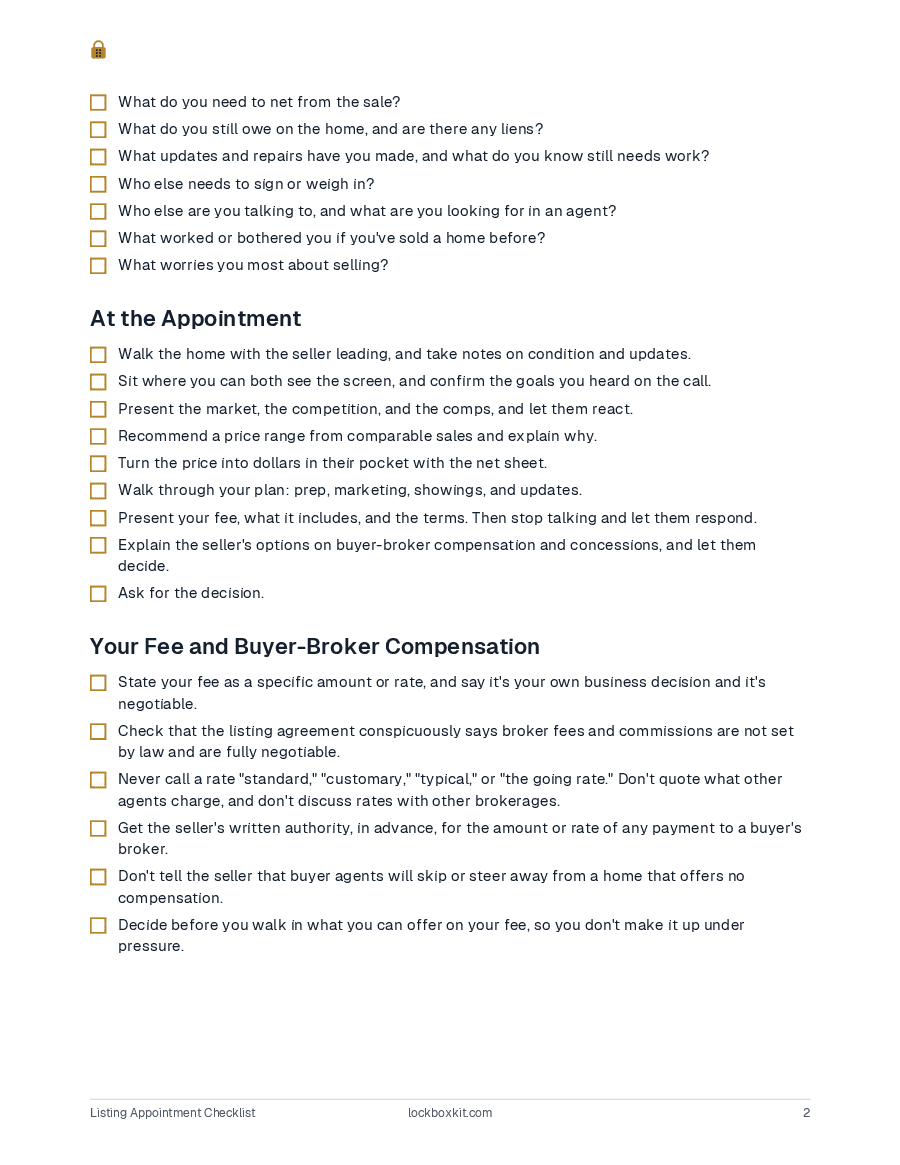
- What do you need to net from the sale?
- What do you still owe on the home, and are there any liens?
The decision
- Who else needs to sign or weigh in?
- Who else are you talking to, and what are you looking for in an agent?
- What worries you most about selling?
If price worries them, show the comps first.
Run the Meeting in This Order
Walk the home first and let the seller lead. Then sit where you can both see the screen, read back the goals you heard on the call, and ask what's changed. Go from the market to the comps to a price range, turn the price into net proceeds, and walk through your plan.
Present your fee and the compensation decision last, then ask for the decision. Block enough time that you don't have to rush the fee conversation. The listing presentation page lays the flow out slide by slide.
Talking About Your Fee Under the Current Rules
Some sellers ask about the fee early. Since August 17, 2024, offers of compensation to buyer brokers can't appear on MLSs that follow NAR's rules, but a seller can still choose to pay a buyer's broker off the MLS.
As an MLS participant, you need the seller's written authority, in advance, for the amount or rate of any such payment, and your listing agreement has to say conspicuously that broker fees and commissions are not set by law and are fully negotiable. State your own fee as a specific amount or rate.
Before we go any further, what do you charge?
Happy to tell you now. My fee is [amount or rate], and I'll show you what it covers. It's my own business decision, and it's fully negotiable. Can I walk you through the plan first, so you can see what you'd be getting?
Don't compare your fee to other agents.
The seller can offer to pay a buyer's broker off the MLS, offer concessions, or decide offer by offer, and the listing presentation page walks through the trade-offs. The Commission Conversation scripts in The Listing Appointment Kit cover answering fee objections.
Compliance: Seller concessions, like help with closing costs, can appear on the MLS if your MLS allows it, but they can't be conditioned on paying a buyer's broker. Never tell a seller that buyer agents will skip or steer away from a home that offers no compensation. Never call a commission "standard," "customary," "typical," or "the going rate," and never discuss your rates with other brokerages. Rules vary by state, MLS, and brokerage. Use your brokerage's approved forms and check with your broker.
Hard Moments
When the seller is interviewing other agents:
We're interviewing a few agents before we decide.
That makes sense, it's a big decision. What matters most to you in the agent you pick?
Someone who'll price it right and keep us updated.
Then let me show you how I got to my price range and how I'll keep you posted. You can compare that to what you hear from the others.
Don't criticize anyone, and don't ask what other agents are charging.
When another agent has told them a higher price:
Another agent said they could list it at [Higher Price].
I can't speak to how they got there. Here's how I got to my range: these are the sales closest to your home, and here's how I adjusted for the differences. If you want to start higher, let's talk about what that could mean for how long it sits.
Don't promise a price you can't support with sales. A CMA is your opinion of a likely price, not an appraisal.
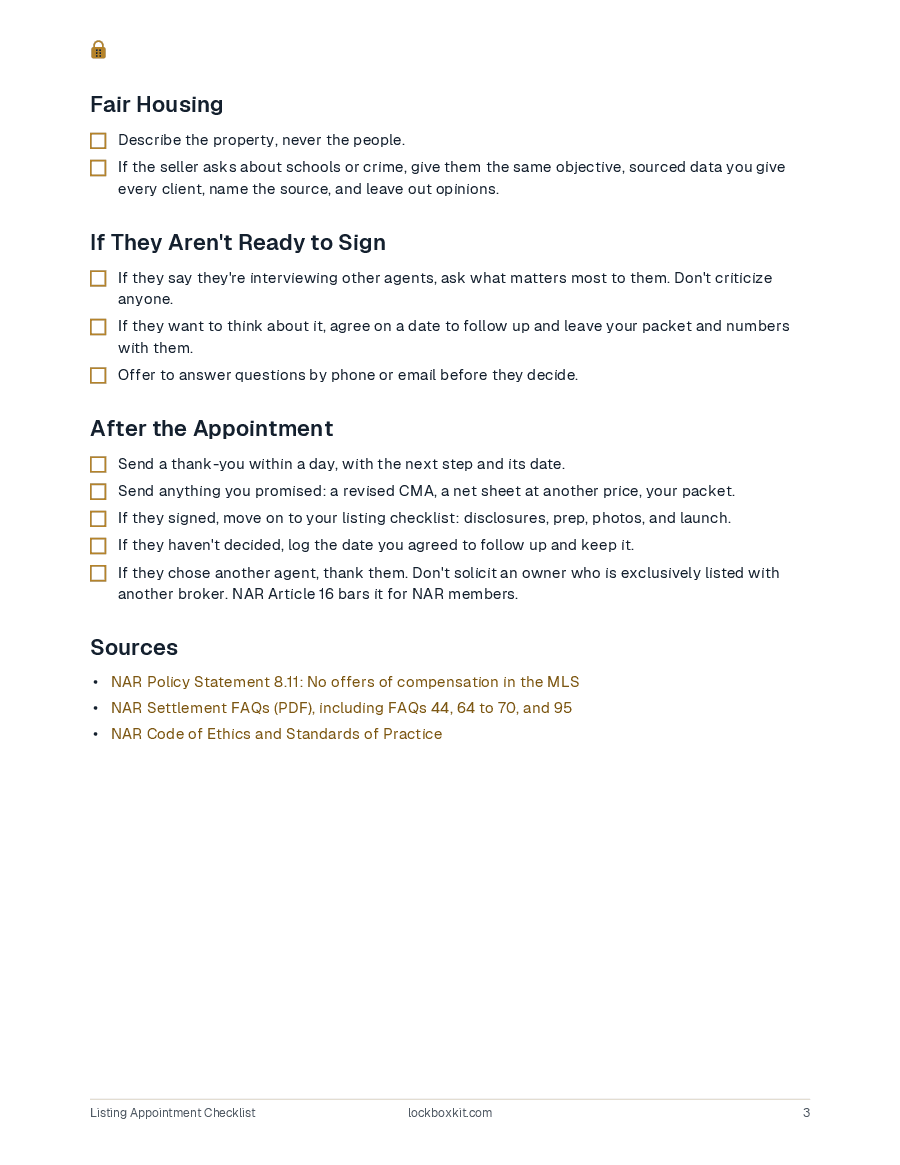
When they want to think about it:
We'd like to think about it.
Of course. Is there one thing you'd want to be sure of before you decide? I'll send over [revised CMA or net sheet] by [Day], and I'll call you on [Date] to hear where you are.
Leave your numbers behind and set the follow-up date before you leave the house.
After the Meeting
Send a thank-you within a day, with the next step and its date. Send what you promised: a revised CMA, a net sheet at another price, your packet.
If they sign, move on to the listing checklist. If they sign with someone else, thank them. NAR Article 16 bars NAR members from soliciting an owner who's exclusively listed with another broker. Once that listing has expired, and you've confirmed it wasn't extended or relisted, Article 16 no longer limits you, but Do Not Call and consent rules still apply to every call or text.
Fair Housing at the Appointment
Describe the property, never the people. If a seller asks about schools or crime, give them the same objective, sourced data you give every client, name the source, and leave out your opinions. Don't tell them it's illegal to discuss, and don't send them elsewhere to find out.
Listing Appointment Mistakes to Avoid
- Presenting before you've asked anything. If you don't know why they're selling or when they need to be out, you're guessing at your pitch.
- Calling a commission "standard." Fees aren't set by law and are fully negotiable, so there is no standard.
- Promising a price to win the listing. Show the sales and give a range.
- Skipping the net sheet. A seller who sees only a list price will compare it with the wrong number.
- Leaving without a date on the calendar. "I'll be in touch" gives the seller nothing to hold you to.
What Sellers Should Expect
If you're selling, expect the agent to ask about your goals and timeline, walk the home, and recommend a price range from recent sales. Ask how the agent is paid, what that covers, and what's negotiable, and get it in writing.
Where the Kit Fits
The free checklist covers the meeting. The Listing Appointment Kit gives you the materials to run it: a 24-slide listing presentation with a talk track in the speaker notes (PPTX and PDF), an 18-slide buyer consultation deck, a 12-section pre-listing packet (DOCX), a CMA template and seller net sheet worksheet (fillable PDFs), and The Commission Conversation scripts for presenting your fee, guiding the buyer-broker compensation decision, and answering fee objections.
It doesn't include listing agreements or legal forms. Those come from your brokerage. See what's in the kit.
Download the free checklist and work through it before your next meeting.
Questions agents ask
What is a listing appointment?
A listing appointment is the meeting where a seller decides which agent to hire. You tour the home, learn what the seller needs, recommend a price from comparable sales, explain your plan and your fee, and ask for the listing. It can happen in person or by video, and the seller may be meeting more than one agent.
How do I prepare for a listing appointment?
Call the seller first, then pull the tax record and prior MLS history, build a CMA, run a net sheet at three price points, and send a short pre-listing packet. Refresh your market numbers the morning of the meeting.
What questions should I ask a seller at a listing appointment?
Ask why they're selling and why now, when they want to be out, what they need to net, and who else is deciding. Write the answers down in their own words.
What should I bring to a listing appointment?
Bring your brokerage's listing agreement and the disclosures your state requires, the form your brokerage uses for the seller's buyer-broker compensation decision, a printed CMA and net sheet, your listing presentation, and a leave-behind with your contact information.
How do I talk about my fee at a listing appointment?
State your fee as a specific amount or rate, and say it's your own business decision and it's negotiable. If you're an MLS participant, your listing agreement has to say conspicuously that broker fees and commissions are not set by law and are fully negotiable. Don't call any rate standard or quote what other agents charge. Rules vary by state, MLS, and brokerage. Use your brokerage's approved forms and check with your broker.